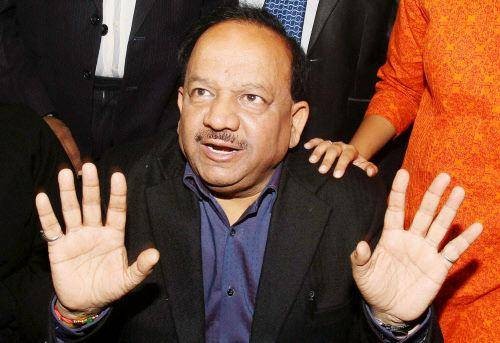
Gandhinagar, Jan 7 (IANS) At the Youth Pravasi Bharatiya Divas here, a glimpse of India's advancement in science and technology was given by union Minister for Science and Technology and Earth Sciences Harsh Vardhan and by top Indian scientists Wednesday.
Harsh Vardhan, addressing the plenary session 'Bharat Ko Mano' to acquaint diaspora delegates with India and its advancement, listed the innovations by Indian scientists, including the various satellites that are helping predict any oncoming cyclone and thus preventing loss of lives.
He said India has the capacity to detect impending cyclones, tidal waves, tsunamis and added that Indian scientists predicted Cyclone Hudhud many days earlier and could save lakhs of lives.
He said India has cooperation with 80 countries in science and technology, including the Bhabha scholarship with the UK to encourage scientific temperament among students.
He detailed a college summit with the US and also cooperation with Japan. He told the youth diaspora that India was instituting fellowships for scientists and technologists living abroad as incentive for them to come back and work for the country.
"We welcome the Indian diaspora to be part of India," he said.
Radhakrishnan, who recently retired as the chief of the Indian Space Research Organisation (ISRO), said in future the global satellite market will tap India's space market. He said there are 1,600 Indian scientists working at ISRO and its Facebook page has close to 900,000 likes who listen in to the scientific discussions.
He enumerated India's successful Mars Mission and added that there are 25 Indian satellites in service in two orbits around the earth. He said that there are lot of commonalities between earth and the Red Planet and with new frontiers being conquered in space technology the day was not far in future when there would be a pravasi coming to earth from Mars.
Manjul Bhargava, Professor of Mathematics at Princeton University, US, said the ancient Sanskrit texts were steeped in mathematical concepts and there was a new way of teaching math based on Sanskrit poetry in ancient India. He said there was a huge amount of math discovered in ancient India.
Jagadesh Kumar, professor at IIT-Delhi, spoke of how nano technology can be used for public welfare. Satheesh Reddy, Scientist and Director Defence Research and Development Organisation (DRDO), said the value of business out of research and development activities of DRDO is around $25 billion.
The morning plenary session on 'Bharat ko Jano' or Know India had eminent speakers talking about ancient India and the culture and tradition of the country.
Among the speakers were Pradeepsinh Bhagwatsinh Jadeja, Gujarat law and justice minister and Non Resident Gujaratis Division, professor Lokesh Chandra, president Indian Council for Cultural Relations (ICCR), and D.K. Hari and Hema Hari, founders, Bharath Gyan.


Prasar Bharati cannot be wished away: Rathore
New Delhi, Feb 13 (IANS) Minister of State for Information and Broadcasting Rajyavardhan Singh
In Gwalior city of Madhya Pradesh, a car owner got so angry at the action of lifting the car of t
Pakistan is facing a serious economic crisis these days. Because of this, a debate has started in
Many states are facing a lack of oxygen following a spike in coronavirus cases. At the same time,
OnePlus phone is the most popular Android phone for its camera and other features. If you want to
Anil Ghanwat Exclusive Interview: Farmer leader Rakesh Tikait is adamant about continuing the agi
Once again there are signs of rising inflation. Everything, including edible oils, spices, tea, c
GST payment deadline for April extended till May 24, relief to taxpayers
The government on Tuesday extended the due date of the April GST payment to May 24. This has been
Thirty children fall ill after mid-day meal in Bihar
Patna, Feb 19 (IANS) At least 30 children fell ill Thursday after having their mid-day meal at
Children are studying through smartphones due to the closure of schools in India, but many famili