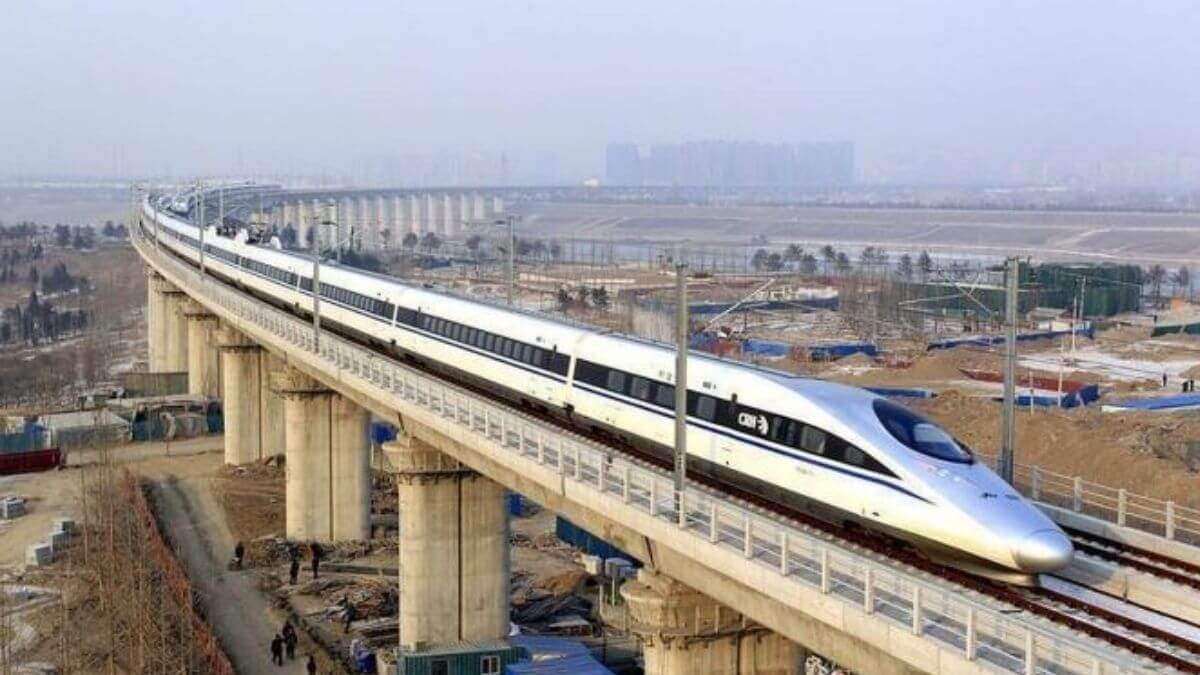
Infrastructure giant Larsen & Toubro (L&T) has won one of the country's largest tenders in the infrastructure sector. The company won the contract with the lowest bid for the design and construction of the construction work of 47 percent of the total length of the Mumbai-Ahmedabad High-Speed Rail Corridor.
A total of three bidders participated in the competitive bidding involving seven large infrastructure companies. Apart from L&T, the bid was by Afcons Infrastructure, IRCON International and JMC Projects India consortium and consortium of NCC, Tata Projects, J Kumar Infra Projects, and HSR. A source familiar with the matter said that L&T bid Rs 24,985 crore for the 237-km stretch of the corridor. The consortium led by Tata Projects had bid for Rs 28,228 crore. If L&T gets the contract, it will be the largest project ever achieved by it. Earlier one of its biggest projects was the Rs 8,000 crore Mumbai Trans Harbor Link (MTHL) project.
A statement by the National High-Speed Rail Corporation said, "The finance bid for the design and construction of a 237-km stretch of the 508-km-long Mumbai-Ahmedabad high-speed rail corridor route was opened on Monday and Larsen & Toubro has entered into Has bid lowest. '
The technical bid for this tender was opened on 23 September and the finance bid has also been opened within a month. Earlier the technical bid was rigorously evaluated. The tender covered 47 percent of the total length of 508 km which is between Vapi (Jaroli village on Maharashtra-Gujarat border) and Vadodara in Gujarat.
Vapi, Bilimora, Surat and Bharuch, Surat Depot are the total four stations in this section. The entire section is in Gujarat where more than 83 percent of the land for the project has been acquired. Implementation of the Mumbai-Ahmedabad High-Speed Project is the responsibility of the National High-Speed Rail Corporation (NHSRCL). According to NHSRCL, this project alone will generate more than 90,000 direct and indirect jobs during the construction phase. It is expected to benefit not only the employment market but also the production and construction market. It is estimated that 75 lakh tonnes of cement, 21 lakh tonnes of steel, and 140,000 tonnes of structural steel will be used in construction and all will be produced in India. Apart from this, the project will also benefit the large construction machine market.
The current high-speed track covers 155.76 km in Maharashtra (7.04 km in the semi-urban area of Mumbai, 39.66 km in Thane district and 109.06 km in Palghar district), 4.3 km in the Union Territories of Dadra and Nagar Haveli, and 348.04 km in Gujarat. The tender has been opened at a time when NHSRCL is working on seven new projects which include Delhi-Varanasi, Mumbai-Nagpur, Delhi-Ahmedabad, Chennai-Mysore, Delhi-Amritsar, Mumbai-Hyderabad and Varanasi-Howrah. Their estimated cost is Rs 10 lakh crore. Indian Railways is going to involve private companies to complete these projects on a public-private partnership model.


Amidst the Ukraine-Russia war, Chinese President Jinping made a big announcement about the war
Worldwide, China is notorious for its expansionist policy. In Ladakh in India, where it has been
Taipei
Furious with China's threats, Taiwan has retaliated by saying that it will fight t
South Korea's Joint Chiefs of Staff said on Friday that North Korea has fired a ballistic missile
There have been 3 big revelations in the last 24 hours in the Umesh Pal murder case of UP. First-
Several schools in the capital Delhi, were thrown into a panic this morning after receiving bomb
Bollywood's Dabangg actress Sonakshi Sinha and actor Zaheer Iqbal's interfaith marriage has recen
How Uttarakhand's Naini Lake turned into a lake of destruction
The record-breaking rain in Uttarakhand has created havoc, especially in the Kumaon region. The m
For some time now, actress Elli Avram's name is being linked with famous YouTuber and actor Ashis
Happiness has arrived at the doorstep of Sachin Tendulkar, known as the God of Cricket. After get
Many children have become orphans in the Corona period. The mother of many children left and the