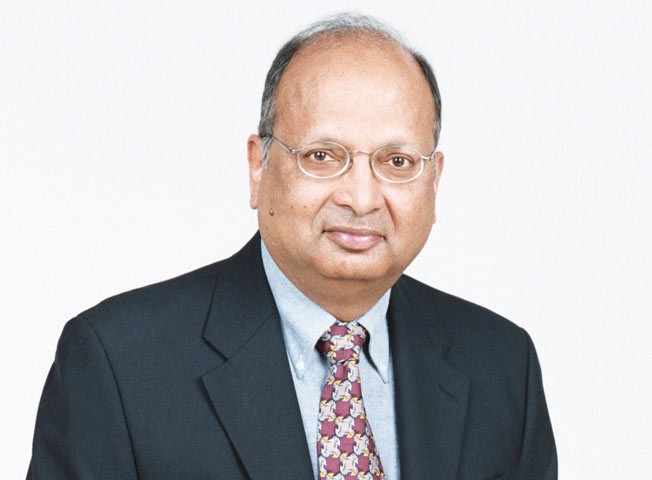
Bengaluru, Jan 10 (IANS) With global security environment rapidly changing due to the weakening of nation states and rise of asymmetric threats, technology would be key to military preparedness, Stanford University emeritus professor Arogyaswami Paulraj said Saturday.
"The changing threat environment and accelerating technology requires a revolution in what defines a soldier, how policy is made and how the intellectual and material capacity for the armed forces is created," the India-born Paulraj said in his keynote address at the second Admiral R.L. Pereira Memorial Lecture, organised by the Navy Foundation and the Bharat Electronics Ltd (BEL).
Admiral Pereira was the ninth naval chief from 1979 to 1982.
Noting that rapidly accelerating technology in the areas of biology, robotics, information, nanotechnology and energy offered a new set of challenges due to asymmetry in the rate of advance of civil versus military technology, Paulraj said lines in the role of military between conventional war fighting and political functions were getting blurred.
"Moreover, new technologies are dual use and what is military versus what is civilian can be hard to separate. Diffusion of civilian technologies the world over will empower irregular forces and sometimes give the latter an edge over regular armies," he said in the lecture on "Accelerating Technology Change and National Security".
Observing that the next few decades would be an era of frequent conflict, involving state, non-state and even individual actors who are willing to use violence to achieve their political and ideological ends, he said such conflicts could result in friction in the world, particularly in the equatorial belt cutting across Latin America, Africa and South Asia.
"Conflicts could arise unpredictably, last from months to years, and be riven by surprises and ambiguities. Future threats can defy simple categorisations - conventional versus unconventional or symmetric versus asymmetric. In a more complicated global security environment, India is among the very vulnerable form a geo-political and technological position," Paulraj noted.
In this context, the Padma Bhushan awardee called for deeper and broader education of the Indian soldier, as they would need understanding of science and technology (S&T).
"If a soldier, who wields the sword, delegates S&T to different or lower tier of soldiers, something vital will be lost, and the soldier will get a sword built for a wrong battle. I also believe that all general officers should have broader education beyond S&T to include humanities, which illuminates how societies and countries function."
Asserting that all general officers should have a master's degree and some of them should go to the top global universities, Paulraj said if a country wanted best weapons, its soldiers also should study at the world's best universities.
"Military training schools or colleges play some role in developing strategic depth, but military needs intellectual inputs. Hence, In India, university think tanks funded by the military can be useful," he said, noting Stanford has such a centre where many former US defense secretaries are professors.
Pointing out that Indian military faced a security environment that could be more difficult and weapons technology driven by an avalanche of change, Paulraj said the new threats could be complex and surprising.
"To be truly prepared, we need organisational modernisation which I believe is more important than equipment modernization," he added.


Controversy has now arisen in Canada regarding the Swastika, the sacred symbol of Hindus. A bill
Prime Minister Narendra Modi will address the countrymen from the Red Fort today. The occasion is
Jaipur. The legislature party is to meet at the residence of Chief Minister Ashok Gehlot in the m
Will do everything to make Obama cherish visit: Government
New Delhi, Jan 18 (IANS) With less than a week left for US President Barack Obama's visit to In
Congress Presidential Elections: It is becoming a difficult task for the Congress high command to
Big news for the students of senior classes in schools across the country. The central government
Before the match between India and New Zealand on Sunday, Indian captain Virat Kohli held a virtu
Houthi: US-UK's major air attack on Houthi rebels in Yemen, tension may increase in West Asia
America and Britain have taken major action against Houthi rebels targeting merchant ships in the
Friday is the 10th day of the Bharat Jodo Yatra in Madhya Pradesh. Rahul Gandhi's yatra reached A
National Institute of Technology (NIT) Jamshedpur has started a better facility for its students.