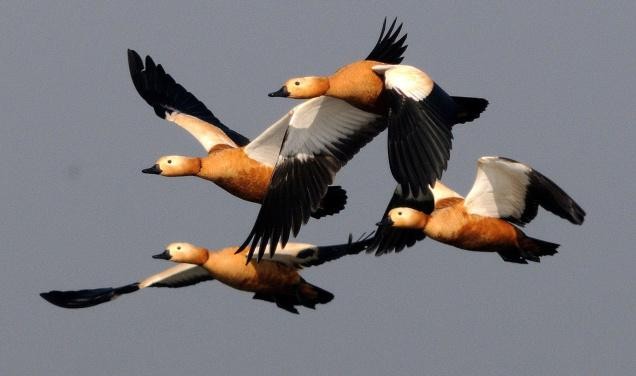
Srinagar, March 26 (IANS) After six months of winter sojourn in the Kashmir Valley, thousands of migratory birds are bidding adieu to return to their summer homes in far off lands.
The increasing cackle, the preparatory flapping of wings and vigorous feeding are some of the signs for bird watchers to know that the spectacle of sound and colour is soon going to end.
"Before beginning their journey of thousands of miles, the birds show significant changes like human beings but with different priorities," said Imtiyaz Ahmad Lone, the Jammu and Kashmir wildlife warden.
The birds will head to Eastern Europe, the Philippines, China and Russian Siberia.
"To ensure cohesion and better communication during the long flight that lasts on an average a fortnight, the cackle increases, the birds peck at each other to remove damaged feathers, feed more vigorously than usual to build energy for the journey and even pin water chestnuts on each other's wings to feed during inhospitable stopovers," Lone told IANS.
This year, according to Lone, more than 800,000 migratory birds of various species spent the winter in water bodies and bird reserves in the Kashmir Valley.
For the first time, Lone's department conducted the Asian water birds' census in the valley along with the Bombay Natural History Society (BNHS). "It was a voluntary effort which will now be a regular feature."
The migratory birds have been coming to Kashmir from time immemorial to ward off the extreme winter of their homes where temperatures freeze water bodies rock solid, making feeding and drinking impossible.
The protected bird reserves of the valley include Hokarsar in Srinagar district, Shallabugh in Ganderbal and Mirgund and Hygam in the district of Baramulla.
Wildlife guards protect the reserve's defined boundaries, prevent poaching, watch bird behaviour and look out for spread of diseases in the habitat.
In addition to the reserves, thousands of avian visitors inhabit the Wullar Lake, Dal Lake and other big and small lakes in the valley.
It is at these unprotected water bodies that poachers move in organised bands during the night to shoot these birds.
This season, anti-poaching squads were moved to the Dal Lake, Wullar Lake, the Narkara water body and some other places, with appreciable results.
Bandipora District Magistrate Shah Faesal ordered people to deposit all licensed weapons in local police stations to give anti-poaching efforts a boost, Lone said.
The migratory birds which fly to Kashmir include greylag geese, mallards, shovellers, wigeons, teals, pochards, Brahmany Ducks and coots.
There are also resident water birds like normal and purple moorhens, debchicks, strokes, kingfishers and herons.
"Then there are cormorants and Sandhills cranes which come to Kashmir to spend some time before moving to the Indian plains," Lone told IANS.
"Interestingly, we have noticed during the last over a decade that many mallards, finding the environment highly hospitable, prefer to stay back to breed in the protected reserves of Hokarsar, Shallabugh and Mirgund.
"This a significant behaviour change which needs a thorough study," Lone added.
Officials noticed no case of bird flu this season.
The mystery of how the migratory birds navigate their long journey with stunning precision has baffled humans.
Flying in highly regimented flocks with the leader in the front, each species flies separately, proving the adage that birds of the same feather flock together.
"It is always the eldest and the ablest bird that is fully familiar with the route that heads the flight," explained Noor Muhammad Wani, 62, of Bandipora.
"Some of the most advanced navigational skills of humans look like child's play when compared to the accuracy with which these birds navigate.
"If the leader dies during the flight or is taken sick, the second in command takes over so that the journey is not interrupted," said Wani, a keen bird watcher whose village overlooks Wullar Lake.
Unfortunately, the traditional homes of the migratory birds in Kashmir are shrinking. But as of now, that is not the birds' main concern.
(Sheikh Qayoom can be contacted at sheikh.abdul@ians.in)


Russia and Ukraine War: Missiles hit the dam in Ukraine, and people were ordered to evacuate
Residents of Krivoy Rih, Ukraine, have been asked to evacuate after missiles hit a large reservoi
Bihar Election: Why did violence happen in Durga idol immersion before voting in Munger?
Munger, immersed in the euphoria of Durga Puja, will wither away before the voting date, hardly a
Thousands of supporters of 'Waris Punjab De' Jathedar Amritpal attacked the Ajnala police station
Every month brings new changes. In this sequence, today i.e. from August 1, some such rules are a
Only a few months are left for the Lok Sabha elections to begin. In such a situation, Congress le
Corona has created a ruckus in China. The increasing cases of coronavirus have increased the conc
Why did Pakistan get angry with India in the special meeting held at the UN on Afghanistan?
On Monday, Pakistan's Foreign Minister Shah Mehmood Qureshi was very active. On Twitter too, he t
Record rainfall in two days has caused heavy destruction due to floods and landslides in Jammu an
India’s Exports Hit Record ₹4.3 Lakh Crore in May, Driven by Gold and Petroleum Shipments
India’s trade sector recorded a strong performance in May as merchandise exports surged 18%
There is good news from Asia's largest slum, Dharavi. Officials say that not a single death has o