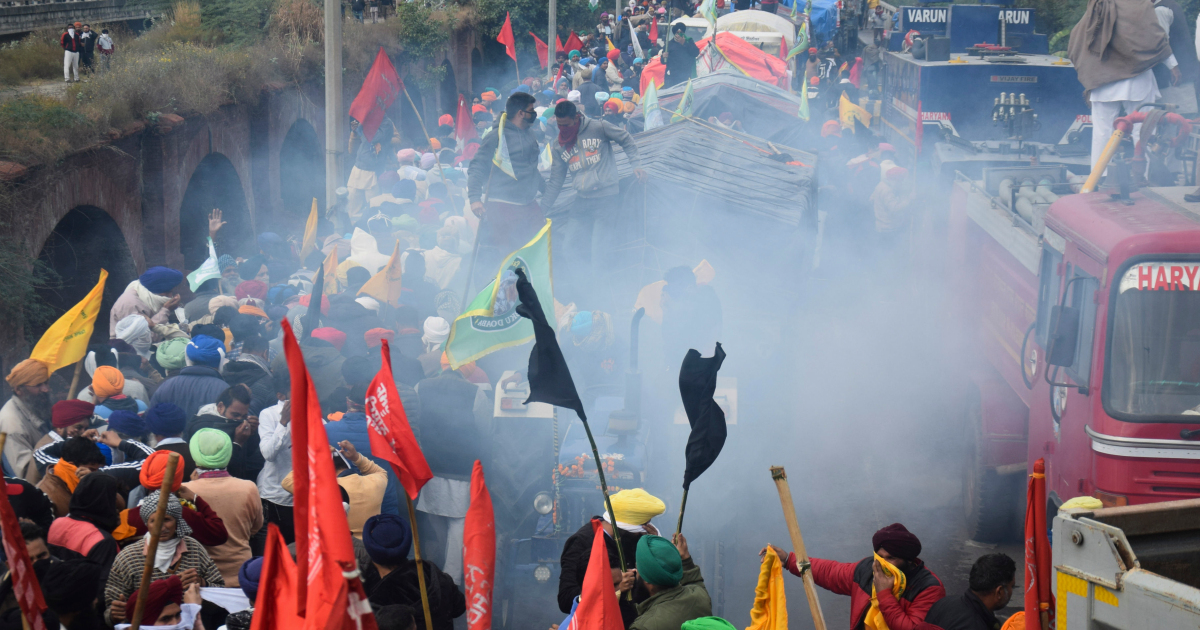
Monday is the fifth day of the demonstration of farmers on the border of Delhi, the capital of India.
Farmers, who are traveling from Punjab Haryana Uttar Pradesh towards Delhi, are opposing three agricultural laws made by the Central Government recently.
According to the All India Farmer Sangharsh Coordination Committee, one of their important demands is, "Government should declare purchases at a price below the Minimum Support Price (MSP) a crime and the government purchases on MSP remain in force."
The Prime Minister himself has tweeted on the MSP saying, "I have said this before and once again I say, the system of MSP will continue, Government procurement will continue. We are here to serve our farmers. We help the donors We will make every effort and ensure a better life for his future generations. "
His tweet is from 20 September 2020.
But the government is not ready to write this in the bill. The government argues that even in its earlier laws, there was no such thing in writing. Therefore, it has not been included in the new bill.
But is it so easy, as is being argued?
Government purchases on MSP are ongoing and declaring the purchase of crops at less than that is a crime, which is not as easy as farmer organizations are feeling.
Why is it difficult for the government to do this?
Before knowing this, it is important to know what MSP is and how it is fixed.
What is MSP?
To protect the interests of farmers, a system of minimum support price (MSP) has been implemented in the country. Even if the price of crops falls according to the market, even then the Central Government buys the crop from the farmers only at the fixed minimum support price so that the farmers can be saved from harm.
The MSP of a crop is the same in the whole country. The Ministry of Agriculture, Government of India, determines the MSP based on the recommendations of the Commission for Agricultural Costs and Prices (Commission for Agriculture Costs and Prices CACP). Under this, 23 crops are being purchased right now.
These 23 crops include crops like paddy, wheat, jowar, millet, maize, moong, groundnut, soybean, sesame, and cotton.
According to an estimate, only 6 percent of the farmers in the country get MSP, of which the maximum number of farmers are from Punjab Haryana. And because of this, opposition to the new bill is also happening more in these areas.
What has changed from the agricultural law so far?
Former Agriculture Secretary of the Government of India Siraj Hussain says that there are some reasons behind the concern of farmers about MSP. The government has not yet issued any such order in writing that government procurement of crops will continue. Whatever is happening till now is verbal. This is one reason for the growing concern of farmers after the new agricultural law.
The thing to note here is that the government procurement will continue, its order is not to come from the Ministry of Agriculture but the Ministry of Food Processing Industries.
The second reason is not to give the Rural Infrastructure Development Fund to the state governments. The central government used to give this fund of three percent to the state governments every year. But this year the central government has refused to give this fund. This fund was used to build rural infrastructure (including agricultural facilities).
After the formation of the new agricultural law, these two important changes are visible to the farmers.
Reason 1: How will the quality standards of crops be determined?
Siraj Hussain says that if the provision of purchase on MSP is added to the law then how will the law be followed? MSP is always for a 'Fair Average Quality'. That is, the minimum support price will be given only if there is a fixed quality of the crop. Now whether a crop fits the quality standards or not, how will it be decided?
What will happen to the crop that will not meet those standards?
In such a situation, if the government also incorporates the demand of farmers in the law, then it will be difficult to implement the law.
Reason 2: Less likely government purchases in the future
Regarding the second reason, Siraj Hussain says that several committees have recommended to the government that the government should reduce the purchase of wheat and paddy. In this regard, the report of the Shanta Kumar Committee to NITI Aayog is with the government.
The government is also working under this objective. This purchase is going to reduce in the coming days. This fear is also haunting the farmers.
In such a situation, if the government will buy the crop or not, then how much, and when it will not be bought, if it is not fixed, then how can the MSP talk in writing in law?
RS Ghuman is a professor at the Center for Research in Rural and Industrial Development, Chandigarh. They have a stronghold on agriculture and economics. In the conversation with the BBC, he has listed many reasons besides the above arguments, due to which the government is not accepting the MSP related demands of the farmers.
Reason 3 - Private companies will not be ready to buy crop on MSP
According to RS Ghuman, if the governments buy less in the future, then obviously farmers will sell crops to private companies. If private companies buy on MSP, then they can be hurt (market prices are not always the same) and if they buy less then they will be sued. (If the government accepts the MSP condition of the farmers).
Therefore, the government does not want to impose this condition on private companies. There are some interests of the government also involved in this and private companies will also have problems with this.
Although holding the post of Agriculture Secretary in the Central Government, Siraj Hussain does not believe that the government does not want to do so due to the dominance of the corporate. They do not accept this argument.
Reason 4 - Farmers may also be in trouble
According to RS Ghuman, the government's hesitation on MSP in terms of the economy can also be understood in another way. For this, it is important to understand two words.
The first word is 'monopoly'. Meaning when the seller sells the same and his own arbitrary, then he charges an arbitrary price.
The second word is 'monopsony'. Meaning that the buyer is only one and he is arbitrary, that is, he will buy the goods at whatever price he wants.
RS Ghuman says that with the new laws passed by the government, 'monopsony' is going to be made in the agriculture sector in the coming days. If only a few companies make a cartel in the agricultural sector, then the farmers will have to sell the goods at the price they decide.
If the provision of MSP is added to the law, then the domination of private companies over farmers can end. The result can also be that these companies will buy fewer crops.
There is no way for the government to force private companies to buy the entire crop on MSP. That too when the government is already making up its mind to buy less crop of farmers.
In such a situation, the problem may also increase for the farmer. To whom will he sell his crop? In such a situation, the MSP may not even be able to remove their cost.
Reason 5: The basis of the price of the crop - the government wants to avoid deciding
Says RS Ghuman, "MSP - gives farmers a minimum basis for fixing the price of the crop, gives a reference point so that the price of the crop is not less than that. The MSP provides them a social security.
Whereas private companies decide the prices of goods according to demand and supply. This is their argument.
Therefore, the government does not want to get into a dispute on both sides.
The government wants to keep this whole issue bilateral. If the provision of MSP is added to the law, three parties will be involved in every lawsuit related to it - one government, one farmer, and a third private company.
What is the solution to the dispute?
It is estimated that 85 percent of small farmers in India have less than five acres of land for cultivation.
RS Ghuman believes that even after declaring the purchase below MSP a crime, the dispute does not seem to end. The only way out is to withdraw all three laws.
At present, the government does not seem to be ready to withdraw the law.
But former agriculture secretary Siraj Hussain says, one way of this is that the government should give direct financial support to the farmers as is being done through the farmer Samman Nidhi.
And the second solution is that farmers should grow other crops that are in demand in the market. At present, farmers put more emphasis on only wheat, paddy and farmers pay less attention to pulses and oilseed. With this, the dynamics of the market will remain.


'Wow Modi ji', how Bill Gates was shocked after seeing Namo app; Special conversation with PM Modi
PM Modi Bill Gates conversation PM Narendra Modi and Bill Gates, who is included in the list of t
Complaints of mobile phones being stolen have been pouring in from the crowded concert of singer
The effect of the strictness and fines of the Directorate of Aviation on IndiGo, the country's la
Uddhav Thackeray's petition against the snatching of Shiv Sena's name and symbol was not heard in
Weather Report, IMD Rainfall Alert, Weather Update Today: Monsoon activities have remained in man
The Elephnat Whisphers : 'The Elephant Whispers' won the Oscar Award, you can watch this film here
Oscar Awards 2023: The audience was eagerly waiting for the Oscar Awards 2023. This time this Osc
If you use Uber app then there is good news for you. Soon you will get a new and amazing feature
Corona cases have increased rapidly in the country. The Health Ministry said that 2,208 new cases
Navyuga, the company constructing it, will bear the expenses of the rescue operation to safely ta
Salman rubbished reports of getting a Rs 1000 crore fee for Bigg Boss 16. This season will start