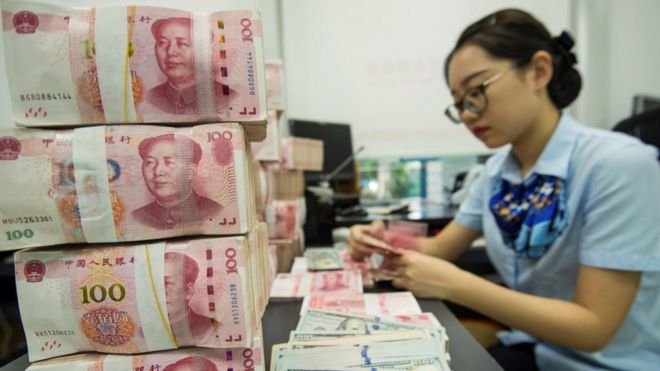
The loans given from financial assistance, business objectives have always been a part of the foreign policy of countries all over the world. But when it comes to China, the word 'debt diplomacy' is mentioned.
Regarding this 'debt diplomacy', Christophe Trebesch, an economist at the Kiel Institute for the World Economy, Germany, says, "Half of the money China lends to developing countries is hidden credits."
This is part of the results revealed in the investigation of Trebesh and Carmen Reinhart and Sebastian Horn. This team has analyzed 5,000 loans distributed by China between 1949 and 2017.
By carrying out the heavy work of searching the information obtained from many sources, an attempt has been made to find out what role China is playing in the world's financial system.
What is its relationship with developing countries? In these developing countries, China has strengthened its roots and this work has been done through the loan of millions and millions of dollars given to the public and private sectors.
These hidden loans are loans that have been given by different Chinese units and it is not easy to get to the bottom. They have been named Hidden Debt or Hidden Credits because they have not been recorded in any international institution.
For developing countries
This study has estimated that the total amount of these hidden debts has increased extensively in the past two decades and has now reached above $ 20,000 million. This figure also includes the combined value of the outstanding debt.
If we talk about the 50 countries which have got the highest loan from China, then research shows that the average debt in these countries has increased to more than 15 percent of the gross domestic product (GDP). In this case, only the figures till 2016 are available.
The bulk of 'direct loans' have been provided through two institutions controlled by the Chinese government. These institutions are - China Development Bank and Exim Bank of China. But, there are also many indirect arrangements through which China provides loans amounts to other countries.
It is a very complicated task to find such loans, because in rare form such loans are taken under the 'Government to Government' system.
Most of the loans are for government-controlled units and the companies that acquire them are also usually the ones who own the main country.
"It is also necessary for the government, taxpayers and risk analysis of the country's financial stability," explains Trebesh, "to find out the level of debt of the country and to whom it owes."
China's dispersal in the global financial system
China's role as a global debtor began to strengthen two decades ago. At that time, China adopted a policy of more openness to the outside world.
At the same time, economic progress was progressing rapidly in China and the importance of China on the international economic scenario was also increasing.
Tribes says, "China has become the world's largest government debtor. No government in the world gives as much debt as China pays."
Using the data of 2018, this study has shown that China owes more than 5 trillion dollars on the rest of the world (including developed countries). This figure is about 6 percent of the world's GDP. 20 years ago this debt was only 1% of GDP.
Although China lends money to all types of economies (including the US where China purchases treasury bonds through its banks), it dominates over low-earning economies.
In this way, China's debt to poor countries and developing countries is more than that of the World Bank and International Monetary Fund (IMF) or any other government.
China's 50 largest debtor countries
The 10 largest borrowers in China include Djibouti, Tonga, Maldives, Democratic Republic of the Congo, Kyrgyzstan, Cambodia, Nezere, Laos, Zambia and Samoa.
If we talk about China's biggest 50 debtor countries, the average debt on these countries has increased from less than one percent of GDP in 2005 to more than 15 percent of GDP in 2017.
From another angle, 40 percent of this group's external debt (external debt) is from China. Among the biggest borrowers of China in this group are three Latin American countries, Venezuela, Ecuador, and Bolivia.
Tribes says that there is no understanding of the increasing dominance over China's financial system.
He says, "We hardly think that China has become a major country for a large part of the world."
According to him, "China's loans will have bad economic consequences on the developing world. Their impact is increasing with time and we need to do more research in this direction."


Now the enemy's heartbeat will increase, soon the Navy will get aircraft career and two submarines
The Indian Navy has also got a new strength with INS Vela. Through this, the Indian Navy can keep
The war between Russia and Ukraine has intensified. Monday marks the 12th day of war between the
Violence continues in Manipur, but in the meantime, good news has come to the fore. National High
What kind of security cover the former governors of Jammu and Kashmir have got, for how long have
Smartphone maker Lava has launched a cheap smartphone in India. This smartphone is Lava Z3, which
Samsung's next flagship smartphone lineup is already generating significant buzz, even though the
G20 Bali Summit: Xi Jinping can meet the Japanese Prime Minister, both are attending the G-20 summit
Japanese Prime Minister Fumio Kishida and Chinese leader Xi Jinping are attending the G-20 summit
'Hindu women were crying, houses and shops were set on fire. There was fear on every face. The Hi
The country's economic growth rate is likely to slow down to 7 percent year-on-year from 1.7 perc
Rupee At Record Low: Rupee falls further against the dollar, reaching a record low of 77.81
The trend of depreciation of the Indian currency against the US dollar continues. The rupee hit a