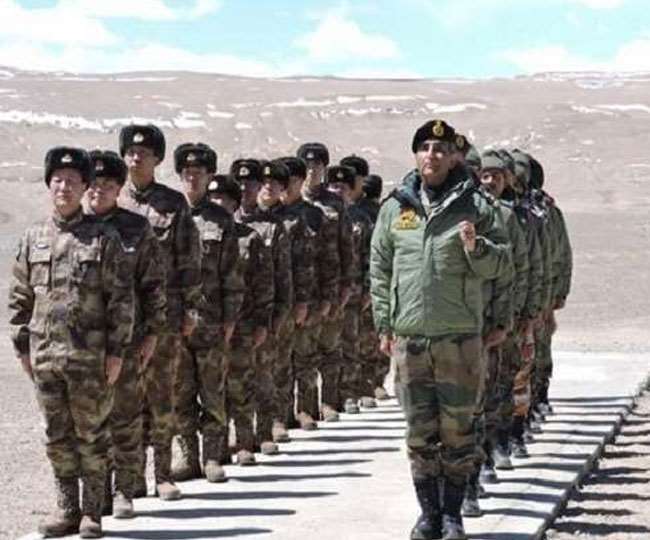
On Monday night, a bloody clash between Indian and Chinese soldiers led to the Chinese People's Liberation Army (PLA) maintaining a checkpoint at India's patrolling point in which 20 Indian soldiers were martyred and more than 40 soldiers from China have been killed.
If this post were not removed, the Chinese could not only see the movement of the Indian Army towards the Karakoram, but would have got the ability to stop the movement of army vehicles on the Darbuka-Shyok-Daulatbeg Oldi (DBO) road. The most important is that this post was made across the LAC across the Indian border.
Foreign Minister SJyashankar raised the issue during a phone conversation with Chinese counterpart Wang Yi on Wednesday, making it clear that the PLA had a planned plan to replace LAC and remove the Indian Army from petrol point 14. If the Chinese Army had succeeded in this, it would have been a great loss for Indian interests.
Point 14 was established by the Indian Army in 1978. One is on a peak from where the Galvan River valley and the Galway River can be monitored, which merge into the Shyok River. Along the way, Indian Army Engineers are constructing DSBO Road.
Hindustan Times, after talks with army high officials and former commanders, has come to know that in a meeting of military commanders on June 6 it was decided how many soldiers could remain at each post till point 14. But while the troops were in retreat, Chinese troops tried to build a surveillance post close to Point 14. This was opposed by Colonel Santosh Babu, the commanding officer of 16 Bihar Regiment.
At sunset on Monday 15 June, Colonel Santosh and his company commander reached Point 14 and asked their PLA counterparts to remove the structure. There was a fierce debate on both sides. More soldiers from both sides reached and started walking. Below the peak near the Galvan River is the base camp of the Chinese PLA, from which a large number of Chinese soldiers arrived with weapons. Initially, the number of Indian soldiers was quite good but the Chinese came out in large numbers.
The Chinese foreign minister told the Indian counterpart that India should punish soldiers who broke the discipline, while the truth is that the Chinese troops crossed the borderline. The Chinese military wanted to replace the LAC by creating surveillance posts there. Before the clash, Chinese officials told Indian officials that the LAC point was beyond 14. This illegal post of China would have weakened India's presence at point 14. This would have given the Chinese army a greater advantage and the Chinese Army could have seen the movement of the Indian Army and would have acquired the ability to disrupt the movement on the DBO road as per its choice.


In Ludhiana, the water of the Sutlej River is causing damage to the Sasrali area of the cit
Jitendra Satish Awhad has been appointed chief whip of the Nationalist Congress Party (NCP) after
COVID lockdown in China: The new wave of coronavirus (Covid-19 cases in China) has once again wor
Bangladesh interim government chief Mohammad Yunus is very angry about the online speech being gi
Big challenge for workers' health In Company and industrial Area
The entire routine of Pawan Singh, who works at the paint shop of Maruti Suzuki, the country's la
Three accused have been arrested in the case of misbehavior with a Japanese girl while applying c
OnePlus phone is the most popular Android phone for its camera and other features. If you want to
A big conspiracy to overturn a train in Gujarat was foiled. The up-line railway track under Vadod
Terrorists Killed In J&K: There has been a big disclosure about two terrorists killed in Kash
There will not be any change in the timetable of roadways buses from night curfew. Buses will com