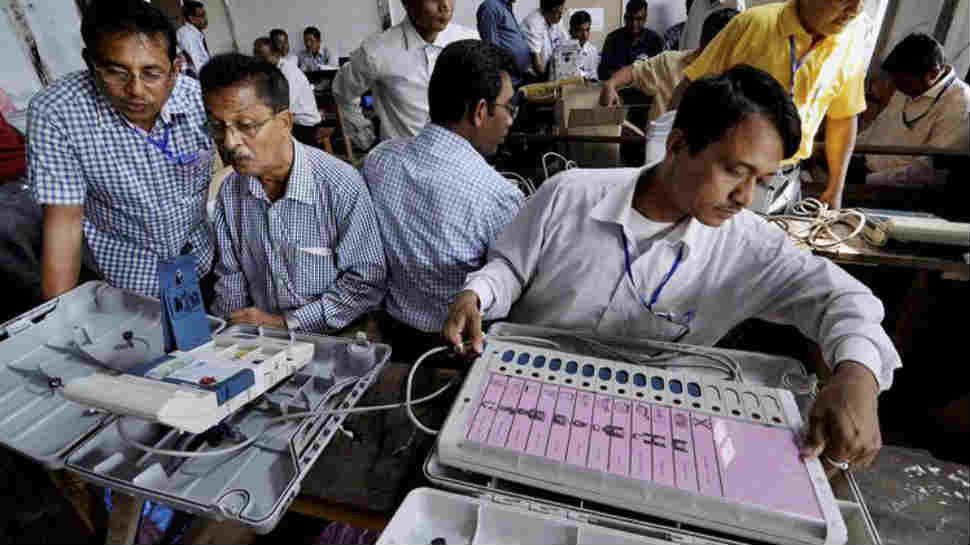
The Election Commission on Monday showed the prototype of the Remote Electronic Voting Machine (RVM) to the representatives of political parties. The commission had called eight recognized national parties and 57 regional parties for the demonstration of this system made voters live away from their homes. However, several opposition parties, including Congress, have opposed the efforts to introduce the RVM system.
During the demonstration of remote EVM, members of the Technical Expert Committee of the Election Commission were also present. The Commission says that with the help of the Remote Electronic Voting Machine (RVM), voters living away from their homes in any other city or state will be able to vote in the Assembly/Lok Sabha elections. That means they will not have to come to their hometown to vote.
16 parties including Congress opposed RVM
The Congress called an all-party meeting on Sunday to discuss the Remote Voting Machine (RVM) proposal. 16 parties including JDU, Shiv Sena Uddhav faction, National Conference, CPI(M), JMM, RJD, PDP, VCK, RUML, NCP, and SP participated in this meeting chaired by Digvijay Singh. Everyone opposed the RVM proposal.
The Election Commission had said that the Multi Constituency Remote EVM can handle 72 constituencies from a single remote polling booth. Here, Digvijay said, 'RVM system is still very incomplete. There are huge political problems in this. The definition and number of migrant workers are also not clear. In such a situation, we do not support RVM.
The commission also wrote a letter to the parties asking for suggestions on RVM
The Election Commission had also issued a note on the technology, inviting parties to demo the prototype. Suggestions were invited from the parties till the end of January on issues such as necessary changes in the law to allow the use of RVM. The parties were asked to express their opinion on this proposal by writing a letter.
RVM based on existing EVM, will not connect to the internet
Election Commission officials termed it a technical challenge to count the votes cast at far-flung booths and send the returning officers to their booths in other states. The commission says that RVM will be developed as a robust, failproof, and effective stand-alone system. It will be based on the existing Electronic Voting Machine, but will not be connected to the Internet.
1. For whom the commission has made this arrangement? Will you be able to vote from wherever you are?
People working in other states, and migrant laborers will be able to use RVM. This will not mean that they will be able to vote sitting at home. To take advantage of this facility of the Commission, one has to reach the remote voting spot on the day of voting. This does not mean voting from home. According to estimates, there are 45 crore people in the country who have left their homes and cities and are living in other states. Its centralized data does not exist.
2. How many constituencies can be covered by one RVM booth?
Chief Election Commissioner Rajeev Kumar said that research was done on the attitude of youth and urban voters not to vote. RVM will be a revolutionary change to increase their participation in voting. Multi Constituency Remote EVM can handle 72 constituencies from one remote polling booth.
3. Will the Election Commission implement it immediately?
No, views of political parties have also been sought on legal, administrative, and technical challenges before its implementation. According to a statement, the poll panel has only issued a concept note on remote voting.
4. Why is the focus of the Election Commission on RVM?
The commission noted that the voter turnout in the 2019 general election was 67.4%. More than 30 crore voters did not exercise their franchise. This is what is bothering me. The commission said, "Voters are not able to register and vote due to various reasons when they move to a new place. The inability of domestic migrants to vote was a matter of concern. Hence, the RVM plan was formulated."
5. So when will this RVM system be implemented? Is it before the elections in 9 states next year?
The Commission called all political parties on 16 January. He will show this RVM system to political parties. After this, he will ask for suggestions. After this, it will proceed with the process of implementation. Apart from Jammu and Kashmir, assembly elections are to be held in 9 states of the country in 2023.
Lok Sabha elections will also be held in 2024. The states where elections are held include Tripura, Meghalaya, Nagaland, Karnataka, Chhattisgarh, Madhya Pradesh, Mizoram, Telangana, and Rajasthan. The implementation of the RVM system depends on the opinion of the demos, political parties, and people involved in the election process.


A ceasefire has finally been declared on the conflict between Thailand and Cambodia that has been
In the NEET paper leak case, 33 members of the solver gang from Purvanchal, Bihar, Jharkhand, Tri
Amazon Great Indian Festival 2026: Sale Starts October 8, Big Deals on Smartphones and Electronics
The festive shopping season is set to get underway with Amazon India announcing the start date of
Dalai Lama: The Dalai Lama kissed a child in public, creating an uproar on social media
Controversy has erupted over a video of the world-famous Tibetan spiritual leader Dalai Lama. A v
The statement of former WFI chief Brij Bhushan Sharan Singh has come to the fore in the matter of
The audience is eagerly waiting for 'Hera Pheri 3'. The film has been in constant discussion for
Former Deputy CM Manish Sisodia, arrested in the Delhi Liquor Policy case, will be produced in th
Many parties have announced their candidates for the assembly elections in Karnataka. After the a
PM Modi in US: How Modi targeted China-PAK on US tour, read what he said to Biden about Russia
Prime Minister Narendra Modi on Thursday held bilateral talks with President Biden at the White H
The Thackeray brothers have surprised everyone with a major decision in Maharashtra politics. Udd