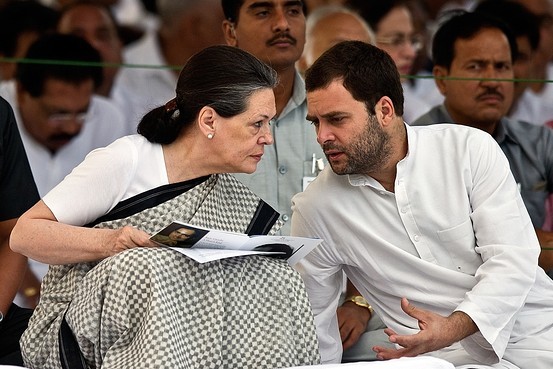
There may be a deeper and more unsettling reason for Rahul Gandhi's present farewell to active politics than the explanation that he has gone away to mull over the factors which led to the Congress's recent electoral reverses.
Even the reticent and reclusive heir apparent cannot be unaware that a spell far away from the madding crowd will not be long enough for him, or anyone else, to understand why the party is facing an "existential" crisis, to quote one of the 44-year-old prince's acolytes, Jairam Ramesh.
Arguably, Rahul Gandhi may want to pore over the various points which he imbibed during his prolonged sessions with party functionaries from the time of the party's crushing defeat in last year's general election.
An atmosphere of peace and quiet is undoubtedly necessary to sort out the many inputs. Even then, what the sabbatical implies is a mentality which is not typical of politicians, who are all invariably extroverts and revel in an environment of bustling activity. Only thinkers seek solitude.
However, there has been nothing to show in the period when Rahul Gandhi has been in active politics that he is of an introspective bent of mind.
This is borne out of the fact that there is nothing out of the ordinary in the idea of organizational elections that he favours for a revamp of the 130-year-old party. Nor in his castigation of the fact that most parties, including his own, are run by closed coteries.
If Rahul Gandhi really wants to do away with such self-serving groups - his father called them "power brokers" - he should have begun by not accepting the vice president's post.
It is possible, therefore, that in addition to the instincts of a haughty loner which is the result of a privileged upbringing, Rahul Gandhi is chafing against the curbs he is apparently facing in the implementation of his ideas.
A hint of his approach was available from the observations of the Congress general secretary, Digvijay Singh, when he said that Rahul Gandhi wanted to "run a Kejriwal-type campaign: open the party up, allow people to come in, put a greater emphasis on mass contact, but unfortunately he was not allowed to give a new direction by the establishment".
It is not easy to make out who Digvijay Singh referred to as the "establishment". To outsiders, the Congress establishment or high command comprises Sonia and Rahul Gandhi. It is their word which is law.
Or is this assessment an over-simplification ? Do the "power brokers" still exist? Have differences arisen as a result between the mother and the son over the running of the organization?
Ironically, there have been suggestions, notably by Congress MP Kamal Nath, about a replay of the Sonia Gandhi-Manmohan Singh diarchy in a new form involving the party president and vice president.
It is necessary to remember that ever since the Aam Admi Party's (AAP) success in December 2013, Rahul Gandhi has spoken of learning from the fledging party.
The AAP "involved a lot of non-traditional people", he said, "and we will learn from that and will better it in a way you cannot imagine". Was he thinking of opening up the party?
The point, however, is whether his shock tactics will bring the Congress into line with his views or whether his escapism will discredit the dauphin more than the royal family.
The answer will lie in his favour if he can come out with a clear formulation not only for breathing new life into the party but also in giving it an ideological direction in sync with the present-day world.
As of now, the Congress is seemingly leaning towards a return to Nehruvian socialism. If it wants to do so, the party must be forthright about it and not hedge its bets by an occasional reference, as by Digvijaya Singh, to the needs of the "aspirational" generation along with the pursuit of a Left-of-centre line.
Clarity of vision is the hallmark of a leader. But it also has to be of the right kind. Otherwise, it can lead the party to the edge of a precipice, as in 1977 and again at present.
Doubts may arise over Rahul Gandhi's outlook not only because of his Left-leaning ideas but even more so because one of his heroines is Indira Gandhi. A combination of his grandmother's Leftism - her ideology was derisively called Left-of-self-interest - with her authoritarianism will be a fatal mix.
It is not only the Congress which will wait eagerly to hear Rahul Gandhi's articulation of his vision when he comes out of his hideout to become the party president. The country, too, will be equally interested in knowing whether he has finally grown up - or remains the dilettante that he appears to be.
(Amulya Ganguli is a political analyst. The views expressed are personal. He can be reached at amulyaganguli@gmail.com)


The Bharat Jodo Yatra of Congress, which is being led by MP Rahul Gandhi, progressed in the Nande
Former India head coach Ravi Shastri has praised young Indian opener Yashasvi Jaiswal for his bri
Bollywood actor Salman Khan's father, Salim Khan, is admitted to Lilavati Hospital, where doctors
Locals in trouble-hit Sandeshkhali in West Bengal's North 24 Parganas district on Thursday celebr
Today is the 26th day of the farmers' agitation against agricultural laws. The farmers have start
Another case like the Shraddha murder has come to light in Delhi's Pandav Nagar. A woman killed h
Corona cases (COVID19 in India) are once again increasing in the country. In the last 24 hours, 2
IPL 2021: RCB Director-General Mike Hessen told- In which order Virat Kohli will bat
The 14th season of the Indian Premier League starts on April 9. Virat Kohli's Royal Challengers B
Since the recent meetings in Uttar Pradesh, the BJP's central leadership has rubbished the specul
India to grow at 7.8 percent, Surpass China: ADB
Manila, March 24 (IANS) India will lead in the Asian region with growth at 7.8 percent in the n