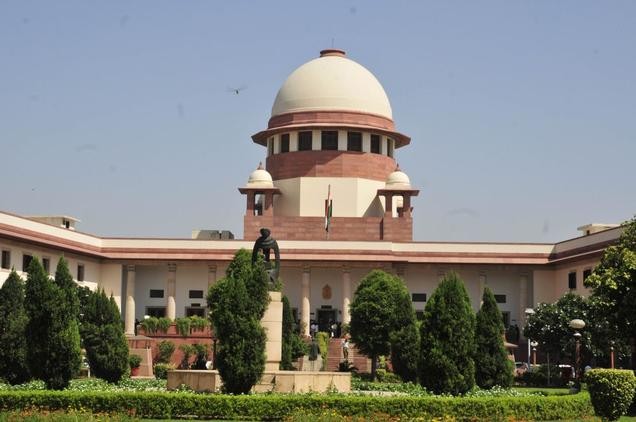
New Delhi, March 24 (IANS) The Supreme Court judgment delivered by Justice J. Chelameswar and Justice R.F. Nariman on Tuesday is likely to go down as a landmark in the history of jurisprudence in India.
The earlier Congress government which brought in Section 66A as an amendment to the Information Technology Act in 2009, and the incumbent government of the BJP which argued for continuation of the section, attempted to take away the freedom of the citizens enshrined under the Constitution. This is clear from the wordings of the judges.
Following are excerpts from the judgment:
“The Preamble of the Constitution of India inter alia speaks of liberty of thought, expression, belief, faith and worship. It also says that India is a sovereign democratic republic. It cannot be over emphasized that when it comes to democracy, liberty of thought and expression is a cardinal value that is of paramount significance under our constitutional scheme.”
“It is clear that Section 66A arbitrarily, excessively and disproportionately invades the right of free speech and upsets the balance between such right and the reasonable restrictions that may be imposed on such right.”
“If Section 66A is otherwise invalid, it cannot be saved by an assurance from the learned Additional Solicitor General that it will be administered in a reasonable manner. Governments may come and Governments may go but Section 66A goes on forever. An assurance from the present Government even if carried out faithfully would not bind any successor Government. It must, therefore, be held that Section 66A must be judged on its own merits without any reference to how well it may be administered.”
“Section 66A does not fall within any of the subject matters contained in Article 19(2) and the possibility of its being applied for purposes outside those subject matters is clear. We therefore hold that no part of Section 66A is severable and the provision as a whole must be declared unconstitutional.”
“It is thus clear that not only are the expressions used in Section 66A expressions of inexactitude but they are also over broad and would fall foul of the repeated injunctions of this Court that restrictions on the freedom of speech must be couched in the narrowest possible terms.”
“Vague laws offend several important values. First, because we assume that man is free to steer between lawful and unlawful conduct, we insist that laws give the person of ordinary intelligence a reasonable opportunity to know what is prohibited, so that he may act accordingly. Vague laws may trap the innocent by not providing fair warning."
“Second, if arbitrary and discriminatory enforcement is to be prevented, laws must provide explicit standards for those who apply them. A vague law impermissibly delegates basic policy matters to policemen, judges, and juries for resolution on an ad hoc and subjective basis, with the attendant dangers of arbitrary and discriminatory application.”
“Information that may be grossly offensive or which causes annoyance or inconvenience are undefined terms which take into the net a very large amount of protected and innocent speech.”
“Section 66A does not concern itself with injury to reputation. Something may be grossly offensive and may annoy or be inconvenient to somebody without at all affecting his reputation. It is clear therefore that the Section is not aimed at defamatory statements at all.”
“Section 66A has no proximate connection with incitement to commit an offence. Firstly, the information disseminated over the internet need not be information which “incites” anybody at all. Written words may be sent that may be purely in the realm of “discussion” or “advocacy” of a “particular point of view”. Further, the mere causing of annoyance, inconvenience, danger, etc., or being grossly offensive or having a menacing character are not offences under the Penal Code at all.”
The judges quoted with approval Justice L.D. Brandeis of the US Supreme Court in his famous concurring judgment in Whitney v. California.
Justice Brandeis wrote: “Fear of serious injury cannot alone justify suppression of free speech and assembly. Men feared witches and burnt women. It is the function of speech to free men from the bondage of irrational fears."
"To justify suppression of free speech there must be reasonable ground to fear that serious evil will result if free speech is practiced. There must be reasonable ground to believe that the danger apprehended is imminent. There must be reasonable ground to believe that the evil to be prevented is a serious one.”


India’s largest IT services company, Tata Consultancy Services (TCS), has made a major pred
Coronavirus in India: Kerala overtakes Maharashtra as Covid-19 cases rise to 724
ज्ञात कोरोनोवायरस मामलों की कुल संखà¥
The Islamic State of Khorasan threatens China with war! Will you avenge the Uighurs?
On 8 October there was a suicide attack on a Shia mosque in Kunduz. More than 70 people were kill
Petrol stock in Sri Lanka is now only one day left. Sri Lankan PM Ranil Wickremesinghe himself ha
President urges Indians to unite to end tuberculosis
New Delhi, March 23 (IANS) President Pranab Mukherjee on Monday urged all Indians to "work unite
A very sensational revelation has come to light in the Birbhum incident. Forensic experts report
The Central Government has issued the notification to implement the Citizenship Amendment Act i.e
The song ‘Sarke Chunariya,’ featuring actress Nora Fatehi and released in March 2026,
Gurguram Vaccination - People Still in line for 12 hours still not vaccinated
The situation of Gurugram, which occupies the first position in the state by putting 19 lakh dose
Kangana Ranaut is very busy these days with the promotion of her film Dhaakad. In this sequence,