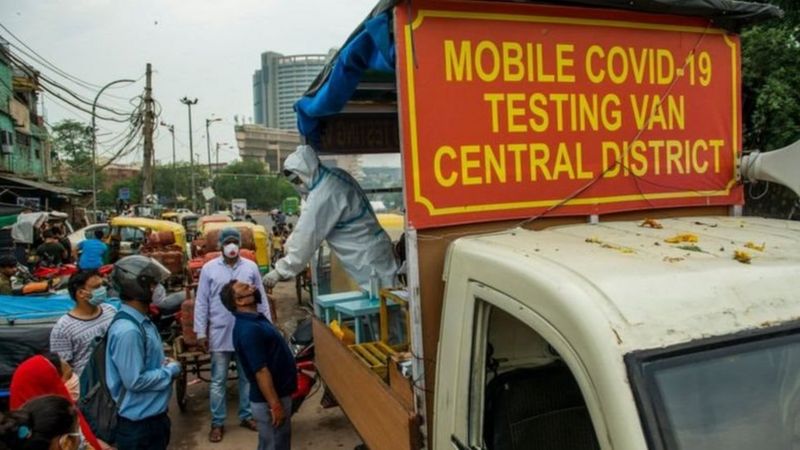
India is entering the 9th month of the epidemic with 5 million cases of Covid-19. Here the cases of infection are second only to America - and more than 80 thousand people have lost their lives.
A government scientist told me that cases of infection in the country are increasing rapidly. The only thing about 'peace' is that the death rate at this time is 1.63%, which is much lower than many countries with more infections in the world.
One reason for increasing cases of infection is that the testing has been increased, but the speed with which the virus is spreading is a matter of deep concern for the experts.
It took India 170 days to reach the first 10 lakh cases, while the last 10 lakh cases increased in just 11 days. While 62 cases were being reported daily in April, in September more than 87,000 cases started coming up every day.
More than 90,000 cases and 1,000 deaths were reported in India in the last week. Those seven states are the worst affected, where about 48% of India's population lives.
But as the infection progresses, life in India is returning on track. Workplaces, public transport, food and drink, gyms have opened up - which are trying to repair the economy which has reached its worst phase after decades.
The world's toughest lockdown forced people to sit in homes, businesses were shut down and there was an exodus of millions of unorganized workers who lost their jobs in cities and returned home on foot, buses, trains.
But a report by Nomura India says that as the economic activity starts, the increase in cases of infection suggests that the "lockdown has failed".
Infection cases may be more than this
So far more than five crore Indians have been tested to detect the virus and more than 10 lakh sample tests are being done every day. But still, the country's testing rate is one of the lowest in the world.
That's why infectious disease experts say that the actual rate of infection in India is much higher than this.
The government's antibody test on random samples of people showed that there were around 64 lakh infection cases across the country in early May, while around 52,000 cases were registered at that time.
Bhramar Mukherjee, a professor of biology and epidemiology at the University of Michigan, is closely monitoring the epidemic. She says that according to her model, there are about 10 crore cases in India at this time.
She says, "I think India is moving towards herd immunity. I don't know if everyone is taking serious precautions like wearing masks and social distancing."
Herd immunity develops when a lot of people develop immunity against the virus.
She says, "It seems like it is normal to have a thousand deaths every day."
As long as the cases of infection continue to grow, it will take time for the economy to fully recover and hospitals and care centers will be filled due to more cases.
K Srinath Reddy, president of Public Health Foundation, an Indian think tank, calls the current surge of infection "the first flow rather than the first wave."
He says, "The waves go out from the starting point, the time of diffusion and the level of rise are different. A rapid flow is formed by joining them, which are still not showing signs of weakening. "
Why are rates going up now?
Dr. Mukherjee says, "The virus will re-grow due to resumption of transportation and less adherence to social distancing, wearing masks and personal hygiene."
A doctor from a large hospital in Jodhpur, Rajasthan, told me that he is seeing an increase in the number of seriously ill patients, who are mostly from joint families.
In April, Dr. Jacob John, a noted virologist, warned that an "avalanche of pandemics" would be coming to India.
They now say that it was "certain" to have more cases of infection in a large country with a dilapidated health system. But so many cases of infection could still be avoided, they believe the reason for the lockdown at the wrong time.
Most experts believe that a partial and properly managed lockdown would have been a better method in some cities that were the epicenter of the transition.
Economist Kaushik Basu says, "It failed because it did what a lockdown shouldn't."
He says, "Because of this, a large number of people across the country walked out on foot to reach home because they had no choice. Because of this, India's economy was damaged and the virus continued to spread."
But public health experts like Dr. Reddy say that lives have also been saved.
He says, "It is not easy to judge the timing of the lockdown imposed at that time, because even in Britain, it was criticized that the lockdown was delayed and it could have saved more lives if it were hurried."
'Every death has its own face'
Infectious disease experts say the lockdown may have had some effect, but it gave India time to learn about the virus and at that time protocols were set for treatment, and surveillance systems were in place, which were present in March Were not.
With the cold weather coming to a close, there are now more than 15,000 Covid-19 treatment facilities in the country and there are more than 1 million isolation beds especially for the patients of this disease.
Like March, there are no reports of masks, safety devices, and lack of ventilators. However, in recent weeks, there have been problems in the supply of oxygen.
Dr. Mukherjee says, "Strengthening the health system and increasing the treatment facility of Covid-19 have helped in reducing mortality."
However, the epidemic brought India's already weak health system into a more difficult situation.
Dwaipayan Banerjee, an expert at the Massachusetts Institute of Technology, says, "If we are trying to understand when the epidemic is weakening and returning, we must remember that health experts, patients and families, are limited in resources We are already doing our best to manage this terrible disease and infection. "
In other words, it is common for India's public health system to weaken and then recover.
But doctors and health workers have worked without a break for months.
"It was very difficult and exhausting," says Dr. Ravi Dosi, who treated more than four thousand Covid-19 patients in a private hospital in Indore. They say that they have been working for more than 20 hours every day since March.
The infection has spread from cities to villages, exposing already deep cracks in the public health system.
Dr. Mukherjee admits, "It will grow at a slow and steady rate until all states are in control."
She says that India needs a long-term federal strategy, not headline management from the government.
Their only hope is that the death rate remains low.
"However, even if the death rate is 0.1% and 50% of the people in India are infected, there will be 670,000 deaths. Every death has its face, it is not just a figure."


Jagdeep Dhankhar recently resigned from the post of Vice President of the country. This decision
The noose has started tightening on the miscreants who created a ruckus during the idol immersion
If the phone is stolen, then track it, know this easy and extremely useful trick
Often incidents of mobile theft occur. There are many problems faced when mobile is stolen becaus
It is said that there cannot be only one medicine for every merge, but after the last World Cup,
Cyclone Biparjoy, which arose from the south-central Arabian Sea on June 6, is moving towards Raj
EC hits back at Rahul Gandhi's fresh allegations that 'votes cannot be deleted online'
Congress leader and Leader of the Opposition in the Lok Sabha, Rahul Gandhi, has once again raise
Senior BJP leader Suvendu Adhikari launched a scathing attack on West Bengal Chief Minister Mamat
Before the Quad conference, China got angry again and made a big prediction
Indian Prime Minister Narendra Modi has reached Japan for the Quad conference to be held in Tokyo
In the 2020 IPL, Rahul Tewatia's bat, who came into the limelight by hitting five consecutive six
Big blow to Congress in Goa, former CM Luizinho Faleiro resigned after praising Mamta; Will join TMC
In Goa, senior Congress leader and former CM Luizinho Faleiro have resigned from the party. There