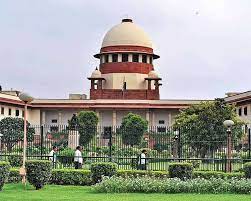
In an important decision, the Supreme Court issued an order to IIT Bombay to hand over his degree to a student suffering from a 'learning disability. The student has done a Master in Design course from the institute. Court ordered that the student has completed his degree. So he should be handed over his degree.
A bench of Justices Uday Umesh Lalit, Ravindra Bhat, and Sudhanshu Dhulia directed the Indian Institute of Technology, Bombay to take appropriate steps to hand over his degree and all other necessary certificates to the appellant Naman Verma within four weeks. The Court has exercised its special power Article 142 in this matter. The court said that the future of the child cannot be left in limbo. Let us tell you that Article 142 is used by the court in very special circumstances.
The Supreme Court was hearing a petition filed by a student named Naman Verma. The student challenged the decision given by the Bombay High Court on April 17, 2018. The student claims to be suffering from learning disabilities. The student had filed a petition before the Bombay High Court in 2013 demanding that he be admitted to the Master in Design course under Article 226 of the Constitution. Based on the interim order of the court, the student got admission to the institute. After this, the student completed his degree.
However, when the time came for the final disposal of the case, after considering various issues, the Bombay High Court did not recognize the right of the appellant under the provisions of the Persons with Disabilities (Equal Opportunities, Protection of Rights, and Full Participation) Act, 1995.
The issue before the Bombay High Court was whether the appellant has completed the course under the interim directions and what will be his fate going forward. In the case, the High Court had said that we are of the view that however the petitioner may be entitled to be declared successful in the course. In the absence of necessary powers under Article, we are unable to grant him any further relief in this petition.
Hearing the matter, the Supreme Court observed that the 1995 Act has now been replaced by the Rights of Persons with Disabilities Act, 2016. The Supreme Court further said that we High Court, however, affirm the view taken by the High Court on issues of law, which came to be determined by the High Court. We do not agree to cancel his candidature because the appellant has completed the course to jeopardize his eligibility.
Also Read: Rajasthan: Rajasthan constable recruitment exam paper also leaked after REET, exam canceled


E-Pharmacy: Preparation to curb e-pharmacy, Union Health Ministry may take big action
E Pharmacy under Radar Union Health Ministry is going to take strict action against the misuse of
Autorickshaw Explodes: Mangaluru blast suspect identified, accused already booked under UAPA
A moving autorickshaw exploded in Karnataka's Mangaluru on Saturday, causing fire and heavy smoke
US seeks allies' support for possible China sanctions over Ukraine war: report
The United States may talk further on the subject to close allies about the possibility of imposi
Significant action has been taken in the case of the mob lynching of Deepu Chandra Das (27), a yo
In Samastipur, Bihar, an incident of shame to humanity came to the fore. On Tuesday, after the po
Taliban: The cruel face of the Taliban came to the fore again, 20 people were flogged in public
Vandalism has continued since the Taliban regime in Afghanistan. Twenty people were publicly flog
'This is Modi's war...', US connects India with Russia-Ukraine war amid tariff war
Hours after US President Donald Trump imposed a massive 50 per cent tariff on India, his trade ad
Arvind Kejriwal has put an end to the news of the alliance between the Aam Aadmi Party and Congre
Jubilee: Prosenjit Chatterjee's outburst, said- "Regional actors don't get much work in Bollywood"
Actor Prosenjit Chatterjee, who will be seen in the upcoming web series Jubilee, revealed that re
India has not lost any series to South Africa in T20 in the last five years. The first match of t