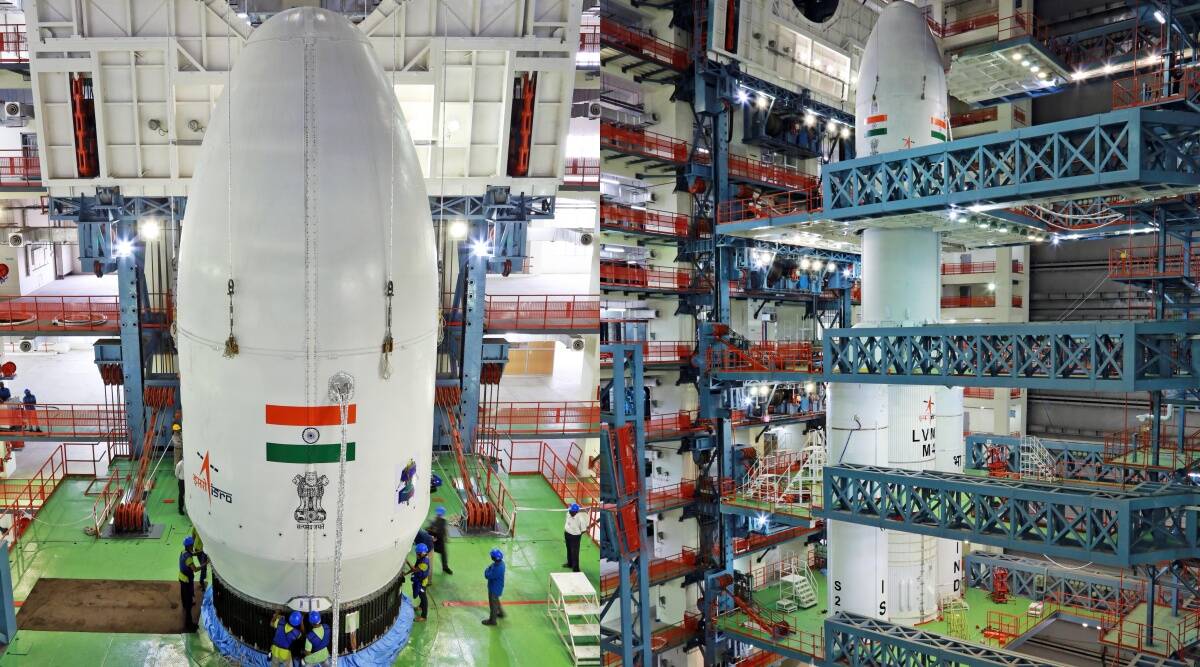
The Indian Space Research Organization (ISRO) on Wednesday attached the encapsulated assembly containing the Chandrayaan-3 spacecraft to its new launch rocket LVM3 at the Satish Dhawan Space Center in Sriharikota, Andhra Pradesh. Chandrayaan-3 is a follow-up mission to Chandrayaan-2, which is expected to demonstrate its full capability to safely land an instrument on the lunar surface and conduct exploration activities from it.
The Bangalore-headquartered national space agency tweeted that the encapsulated assembly containing Chandrayaan-3 was joined with LVM3 at the Satish Dhawan Space Center in Sriharikota today. ISRO has said that the Chandrayaan-3 mission will be launched between July 13 and July 19. An ISRO official said, "We aim to launch it on July 13."
The Chandrayaan-3 mission will carry instruments to study the thermophysical characteristics of the lunar crust, the frequency of lunar earthquakes, the plasma environment on the lunar surface, and the composition of elements near the landing site. According to ISRO officials, these scientific instruments mounted on the lander and rover will be under the theme 'Science of the Moon', while the experimental instruments to study Earth from lunar orbit will be under the theme 'Science from the Moon'.
Dr Sita, former director of ISRO's Space Science Program Office, told that Chandrayaan-3 will have a propulsion module, which will carry the lander and a rover and this will enable them to reach the lunar orbit.
"It is expected that the lander will land on the soft surface of the lunar polar region, and the rover will come out from it and start rotating on the lunar surface," he said. We expect it to observe the properties of the Moon's surface. Some 'payloads' will also go with the lander and they will also do various experiments on the surface and investigate.
According to Dr. Sita, the experiments will be carried out during one lunar day i.e. it will take about 30 Earth days. He said, after about 15 days there will be night and the temperature will drop to minus 170 degrees centigrade or less. The situation will change in the next 15 days. We cannot say how much and what effect the cold will have on the lander. But, the first 15 days will be very important.
In March this year, the Chandrayaan-3 spacecraft completed the required tests, during which the spacecraft's ability to withstand the harsh vibration and acoustic environment during launch was confirmed. These tests were particularly challenging, because the Chandrayaan-3 spacecraft, which will be launched by LVM3 (Launch Vehicle Mark-III) (earlier known as GSLV Mk III), will consist of three modules - Propulsion is a combination of lander and rover.
The lander will be equipped with the capability to soft-land on a specific spot on the Moon and deploy the rover, which will conduct chemical analysis on the lunar surface.


Mumbai Indians captain Hardik Pandya has been fined for violating the code of conduct i
"Between 10:30 and 11:30 pm, the mob attacked pelted stones, and set vehicles on fire. People wer
Where will Priyanka Gandhi sit in Lok Sabha, will her seat be next to Rahul, know here
Priyanka Gandhi, the newly elected Congress MP from Wayanad Lok Sabha constituency in Kerala, wil
There is anger in the whole country over the incident of rape and murder of a female doctor in Ko
Home Minister Amit Shah will inaugurate the Archaeological Experiential Museum in PM's hometown V
Even after the announcement of imposing a 50 percent duty on India, the government will have to p
Bollywood's 'Dabangg' actress Sonakshi Sinha is going to tie the knot soon. Sonakshi will become
Prime Minister Narendra Modi appealed to the Bharvad community of Gujarat to adopt natural farmin
The Indian team entered the final of the ODI World Cup after 12 years. The Rohit Sharma-led India
Former Indian spinner Ravichandran Ashwin surprised everyone by announcing his retirement from th