New Delhi, Jan 29 (IANS) On a sunny evening, under a clear blue sky, with a bracing breeze fluttering the tricolour, 1,000 bandsmen of the Indian armed forces brought music alive on Thursday at the Beating Retreat ceremony which brings the curtain down on the four-day Republic Day celebrations.
Over time, there have been innumerable changes in the selection of music for the occasion but this year's ceremony was exceptional in that 20 of the 23 tunes were by Indian composers and here lies the rub: Not all the tunes could be classified as marches and to that extent, they took away much of the military aspect.
Thus, while debutants “Vir Bharat”, “Chhana Bilauri”, “Jai Janam Bhumi” and “Athulya Bharat” were rousing enough and served their purpose, “Anandloke” sounded more like a lullaby than the slow march it was supposed to be.
Then, the “Dashing Desh” fusion began with a lone flute and with clarinets, bassoons, saxophones, trumpets and drums joining in before yielding to the flute -- a work more appropriate for a concert hall than for the grand Vijay Chowk square at the foot of the Raisina Hill where the Beating Retreat ceremony is held.
Then, “Glorious India” opened as fanfares should but then went into what could be loosely called a dance number.
What did work was the experimental “Salaam to the Soldiers” slow march, interspersed with strains of “Aae Mere Watan ke Logon”.
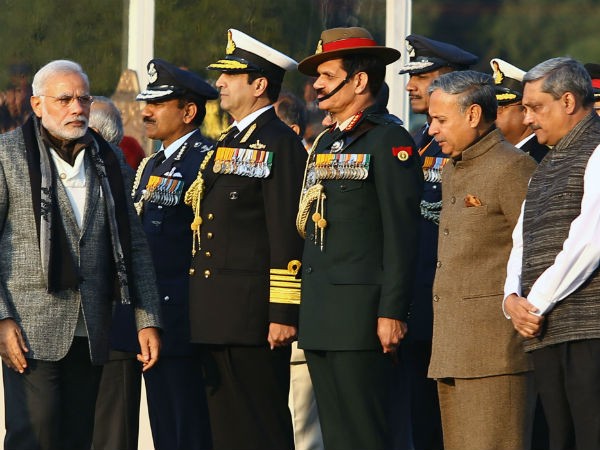
Still, this is not to detract from the magnificence of the hour-long ceremony, which began with the arrival in state of President Pranab Mukherjee, to be received by Prime Minister Narendra Modi, Defence Minister Manohar Parrikar, his deputy Rao Inderjit Singh and the three service chiefs.
The massed bands then made their entry with a soul-stirring version of “Deshon Ka Sartaj Bharat” that never fails to bring on the goose pimples.
At the bottom line, the Beating Retreat ceremony is about more than just music - while this is its raison d'etre. There's the precision marching, the intricate patterns created and the precise timing, with much of the music being played without a conductor.
The other fascinating feature of the ceremony is that the bulk of the bandsmen would have been village lads when they signed up and would perhaps never have seen a musical instrument barring perhaps a flute made out of a reed.
Such is the expertise of the armed forces that they are not only able to hone these lads into soldiers but also expert musicians.
And then, there were the uniforms. While the Indian Army's bandsmen were in olive green or black trousers and white anklets, their tunics dazzled in a range of colours from red to olive green to orange to purple - and with gold-trimmed matching headgear and waistbands.
In contrast, the musicians from the Indian Navy and the Indian Air Force were elegant in their simplicity - the former in black tunics and trousers, white anklets and caps and black and white waistbands and the latter similarly in blue.
By now, the sun was slowly going down, bathing the sky in bright orange and this was the cue for the mass bands to advance for one last time.
Major Girish Kumar U, the principal conductor of the ceremony, led the bandsmen through the eternally haunting “Abide With Me”, favourite of Mahatma Gandhi with the bells in the belfry of the North Block etching out the theme before returning it to the massed bands.
Major Girish Kumar sought the president's permission to conclude the ceremony, the Retreat was sounded, the tricolour was lowered - by a woman officer - and the bands exited - to what else but “Saare Jahan Se Aacha”.
The last of the bandsmen had barely crested the hills when tens of thousands of bulbs on Rashtrapati Bhavan, the North and South Blocks that flank it, Parliament House, Rail Bhavan and Air Headquarters came alight, bathing the scene with an ethereal beauty.
It was time to go home and hopefully return a year later - such is the pull of the event.
For the record, 15 Indian Army brass and 18 pipes and drums bands, as also one each from the Indian Navy and the Indian Air Force, participated in the ceremony.
Subedar Suresh Kumar was the conductor of the Indian Army brass bands. Subedar Mitter Dev led the pipes and drums, while the buglers performed under Subedar Prabhakaran.
The Indian Navy and the Indian Air Force bands were under the baton of Master Chief Petty Officer (Musician-I) Ramesh Chand.
Beating Retreat owes its origins to an ancient custom when warring armies would call a halt to fighting at sundown, case colours and standards and lower flags to attend to the wounded, and eat and rest.
The present ceremony dates to the early 1950s when Major Roberts of the Indian Army developed this unique display by the massed bands.


Lohia left a deep impact on Indian politics: Modi
New Delhi, March 23 (IANS) Prime Minister Narendra Modi on Monday paid tribute to Ram Manohar L
The fight for the Maratha reservation also intensified after the EWS quota for the economically w
More than 100 world leaders are about to discuss a formidable problem that scientists call Earth'
New Delhi
In the last two weeks, as the cases of Coronavirus infection in
Only help with accurate Corona infection data
With the increase in coronavirus cases in Delhi, the information provided under the Health Bullet
A big update is coming out on the Atul Subhash suicide case. In the case, Akash Jindal, the lawye
China will support stabilize Pakistan's financial situation: President Xi Jinping
The Prime Minister of Pakistan is on his first two-day visit to Beijing. Where he met Chinese Pre
Prime Minister Narendra Modi while addressing the US Parliament said that India is the mother of
Delhi: Drone seen above PM Modi's residence, SPG and police stirred, agencies engaged in the search
The news of a drone flying over the Prime Minister's residence on Monday morning created a stir.
Bahubali MLA Mukhtar Ansari was presented in Mohali court on Wednesday. Mukhtar Ansari was presen