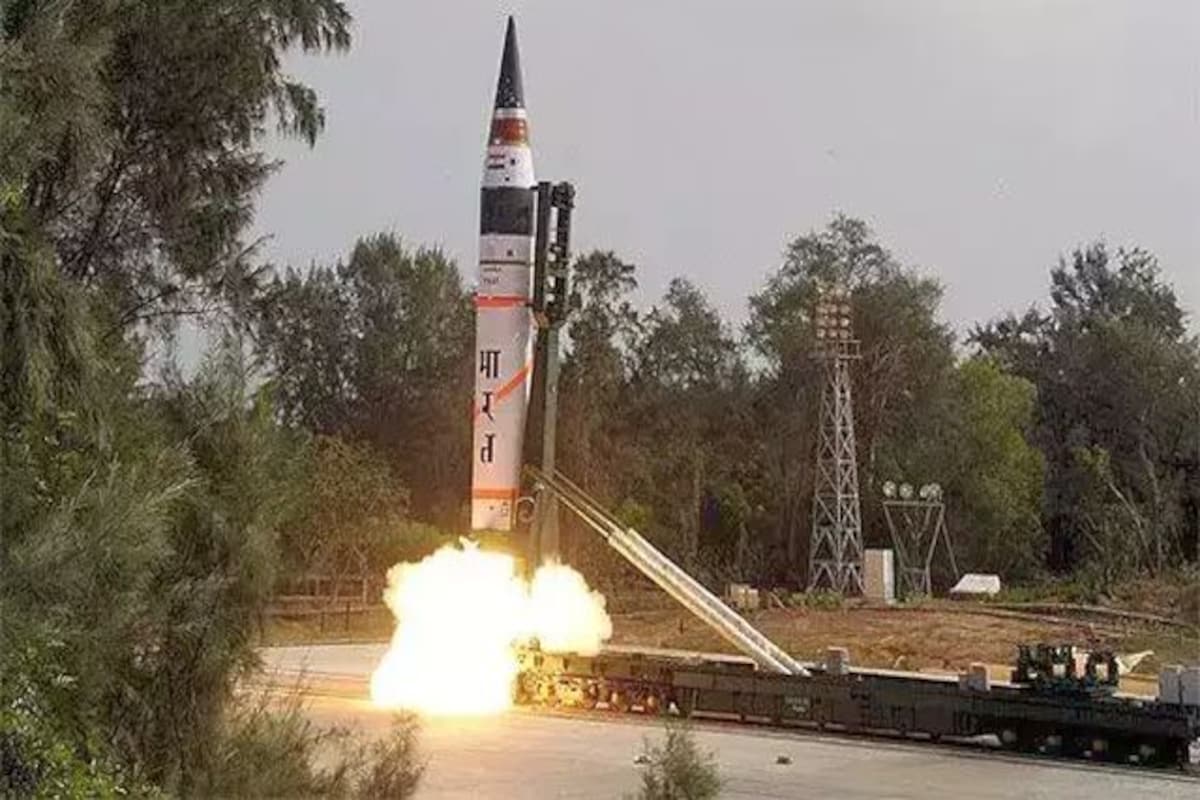
India successfully tests the night trial of the country's most powerful intercontinental ballistic missile Agni-5 on 15 December. The missile has been fired at the full range for the first time from Abdul Kalam Island in Odisha. It successfully destroyed the target by going 5500 km away.
Many ministers of the central government also congratulate DRDO by tweeting. At the same time, a website that monitors the news of defense has claimed that it is not a test of Agni-5, but of a hypersonic glide missile. This claim has been made after analyzing the height, speed, and trajectory of the missile during the test.
Flying at low altitude brings it into the category of a hypersonic missile
Independent defense experts say that the way the Agni-5 missile flew very low in the earth's atmosphere at the time of the test clearly shows that it was not a ballistic missile. Experts say that a ballistic missile first goes into space. After this, from there it goes towards its target.
According to Indian Aerospace Defense News ie IADN, a website analyzing defense news, this test is like a hypersonic glide vehicle. The reason for this is low trajectory i.e. flying at a low altitude. In a Twitter thread, IADN posted a picture of the launch of China's hypersonic missile DF-ZF HGV in 2018 and compared it to Agni-5.
It has been told that the launching of both these missiles is the same. IADN has said in its tweet that seeing the pictures of the Agni-5 missile test recently, it cannot be called the test of a ballistic missile. The video posted by the local people shows that the missile changes direction after going up a steep curve, whereas this does not happen in the test of the ballistic missile.
DRDO is engaged in making hypersonic missiles since 2018
Defense expert Lt Col (retd) JS Sodhi says that the possibility of it being a hypersonic missile cannot be ruled out, as the range and speed of Agni-5 are similar to hypersonic missiles. Defense Research and Development Organization ie DRDO successfully tested Hypersonic Technology Demonstrated Vehicle ie HSTDV in 2020. If seen, DRDO has been working on hypersonic missiles since 2018.
Also, India is engaged in the development of the BrahMos-II missile, which is a hypersonic missile, in collaboration with Russia. BrahMos-II will have a range of up to 1500 km and a speed of 7-8 times that of sound (around 9000 km/h). Its testing is expected to be done by 2024.
Now know what is a hypersonic missile?
All of you must have seen torrential rain accompanied by thunder. You will also remember the flash of lightning with the loud banging sound. During this, the sky is filled with white light, but its explosion is heard long after the glare. That is, the voice is left far behind. Hypersonic missiles are just like this.
10 times faster than the speed of sound. In other words, by the time this missile destroys the target, its sound is 10 times behind.
Know 5 special things related to hypersonic missiles
1. Speed is 5-10 times faster than sound
Usually, hypersonic missiles have a speed of Mach 5, ie 5000-6000 km/h. The speed of the Agni-5 missile is Mach 24 i.e. 24 times faster than sound.
2. Difficult to catch hypersonic missiles
The most important thing about these missiles is that due to their high speed, and low trajectory, ie flying at low altitudes, it is difficult to catch them from any radar in the world including America. For this reason, no missile defense system in the world can kill them.
3. Capable of carrying nuclear weapons
Hypersonic missiles are capable of carrying several tons of nuclear warheads. These missiles can carry 480 kg of nuclear warheads or conventional warheads.
4. More destructive than common missiles
Hypersonic missiles are more lethal than subsonic cruise missiles in destroying underground weapons warehouses. According to defense experts, hypersonic missiles are more destructive due to their extremely high speed.
5. Capable of changing direction in the air
These missiles specialize in maneuverable technology ie changing the path in the air. Due to this, they can also target the changing target. This ability makes it difficult to escape from them.
How many types of hypersonic missiles are there?
There are two types of hypersonic missiles – hypersonic cruise missiles and hypersonic glide vehicles.
1. Hypersonic Cruise Missile
The hypersonic cruise missile uses a high-speed jet engine to reach its target, which enables it to achieve a speed of 5 times the speed of sound (Mach 5). It is a non-ballistic missile. It works differently from ballistic missiles, which use the force of gravity to reach their targets.
2. Hypersonic Glide Vehicle
Hypersonic Glide Vehicle is launched from a rocket. After launch, the glide vehicle separates from the rocket and glides toward the target at a speed of at least Mach-5.


Lok Sabha elections are currently going on in the country. Voting has taken place in two phases.&
SIP vs PPF: Which Investment Will Create a Bigger Education Fund for Your Child in 18 Years?
Planning for your child’s higher education has become more important than ever in today&rsq
Ravichandran Ashwin is one of the best spinners India has ever produced. His statistics testify t
A press conference was held today in Patna by the Union Home Ministry. Union Home Minister Amit S
Aam Aadmi Party (AAP) leader and MP Raghav Chadha announced his resignation from the party on Fri
A major accident was averted in Kanpur, Uttar Pradesh. Train number 19168, Sabarmati Express dera
Indian opener KL Rahul scored his 11th century in his Test career against the West Indies. He sco
The sentence will be announced today in the RG Kar case of Kolkata, the capital of West Bengal. A
One Nation One Election Before the Lok Sabha elections in 2024, the Central Government has raised
The IPL 2024 season is now slowly reaching its final stage where all the team