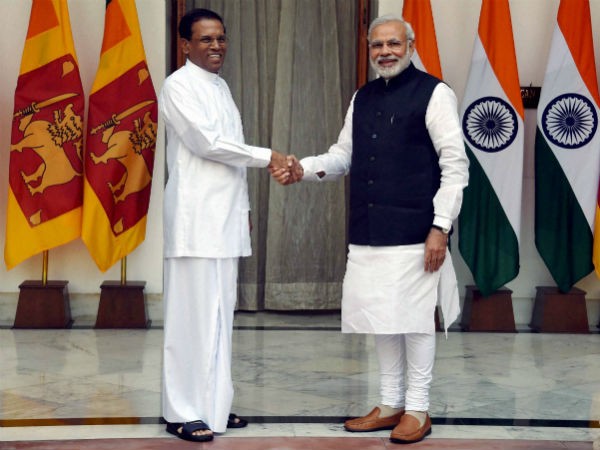
New Delhi, Feb 16 (IANS) India and close neighbour Sri Lanka Monday sought to begin a new chapter in their ties as the island nation's newly-elected President Maithripala Sirisena, on his maiden visit abroad since taking over last month, held talks with Prime Minister Narendra Modi here and the two sides inked four agreements, including one on civil nuclear cooperation.
Sirisena, who defeated long-time president Mahinda Rajapaksa in the Jan 8 presidential election, signalled the new closeness in bilateral ties, saying Modi is expected to visit his country in March and that they are "eagerly awaiting the glorious event", which he said would be "an honour and a blessing" to their country.
Modi's likely visit would be the first bilateral visit by an Indian prime minister to the island nation in over 25 years.
Addressing the media after the delegation-level talks held at Hyderabad House, Modi said the agreement on civil nuclear cooperation was "yet another demonstration of our mutual trust".
He said it is the first such agreement that Sri Lanka has signed and it "opens new avenues for cooperation, including in areas like agriculture and healthcare".
The two sides held talks on the issue of peace and reconciliation process in the island nation over a working lunch.
Ties between the neighbours had come under strain under the Rajapaksa government, especially on the issue of arrest and incarceration of Indian fisherfolk and over Sri Lanka's increased dalliance with China.
he berthing of a Chinese submarine in Colombo port had caused consternation in India.
Congratulating Sirisena on his election, Modi said: "India is Sri Lanka's closest neighbour and friend. The goodwill and support of the people of India will always be with you." Modi had been one of the first leaders to congratulate Sirisena after his election victory.
He also assured Sirisena of "India's commitment to its development partnership" which would continue to cover areas, including infrastructure.
Both sides have also agreed to expand their defence and security cooperation, including in maritime security cooperation and in trilateral cooperation with the Maldives, another geo-strategically important Indian Ocean neighbor of India.
The four agreements inked are on cooperation in the peaceful uses of nuclear energy, on cultural cooperation, a MoU on establishment of Nalanda University, and a MoU on cooperation in agriculture.
On the ticklish fishermen's issue, Modi said both leaders "attach the highest importance to the issue" and have agreed for a "constructive and humanitarian approach" to it.
He said that the Indian assisted projects for the Tamil displaced had made excellent progress, including more than 27,000 houses which have been constructed.
On boosting economic cooperation, Modi said in view of India enjoying a huge trade surplus with Sri Lanka, he had voiced his support "for a more balanced growth in trade in both directions" and for promoting "greater flow of Indian investments and tourists into Sri Lanka".
The commerce secretaries of both sides are to meet soon to review bilateral commercial ties.
"We are at a moment of an unprecedented opportunity to take our bilateral relations to a new level. This visit today has set us firmly in that direction," said Modi.
Sirisena, stressing on the close civilizational links between the two countries, said that Hindu and Buddhist philosophy has influence in his country and that Hindu and Buddhist devotees are living very peacefully and represent the close ties.
He said during talks with Modi, both sides came to "several good conclusions to strengthen ties and strengthen the friendship and we were able to able strengthen that friendship".
He said the friendship between the two countries will not only help build stronger relationship between them bilaterally "but in international forums India will support us and have more understanding between the two countries; building more relations and strengthening the ties, and we agreed to work on a mutual understanding, and it is very clear."
His statement indicates that Sri Lanka is keen that India support Colombo in the UN Human Rights Council (UNHRC) council session in Geneva in March.
Sirisena also said that both sides have agreed to work closely on issues including trade, energy, defence, security, education and culture.
He said his first official visit to India has "borne very fruitful results" and helped bring the relationship to "greater height" and added he believed that both sides would strengthen ties in future in the fields of defence, economy and culture.
Earlier, he was accorded a ceremonial reception at the Rashtrapati Bhavan and later went to lay a wreath at Raj Ghat, the memorial to Mahatma Gandhi.


Amid the controversy over Ranveer Allahabadia's obscene comments on the show 'India's Got Luttent
Union Minister Prad Joshi has sharply criticized Congress President Mallikarjun Kharge. Prahlad J
India-UK FTA: India and UK can sign FTA this year, Commerce Secretary said this
India and UK may sign Free Trade Agreement (FTA) this year as both countries have reached a conse
Bluntly: High Court said - Twitter has to follow the new IT rules
After all the protests, the microblogging site Twitter has agreed to several new guidelines of th
DHCBA to take complaints about judicial system
New Delhi, Feb 20 (IANS) The executive committee of the Delhi High Court Bar Association (DHCBA
There was an explosion in a vehicle on Wednesday in Larkipora of Anantnag in South Kashmir. Eight
Haryana Deputy Speaker Ranbir Gangwa and Hisar Mayor Gautam Sardana's wife participated in the vi
In the last Super Four match of Asia Cup 2023 against Bangladesh, the Indian team had to face def
On January 9, a major accident kept happening at the Bangalore airport. Here two Indigo Airlines
Shahid Afridi On Yasin Malik: Former captain of Pakistan cricket team Shahid Afridi has come out