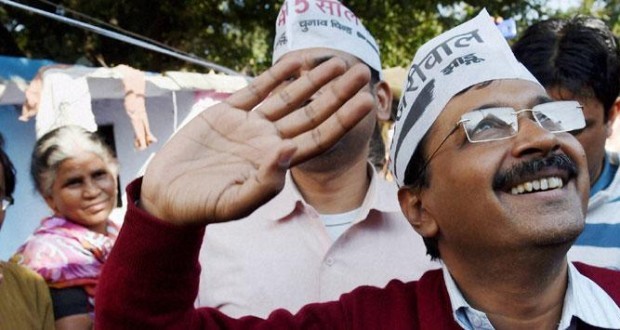
The first fallout of the Aam Admi Party's (AAP) spectacular victory in Delhi will be a renewed focus on sleaze in public life. This was the issue which was the mainstay of Anna Hazare’s anti-corruption movement of which the present-day AAP was a part and which built up Arvind Kejriwal’s reputation as a crusader against bribery and underhand deals.
Since this image is behind his political success, he is bound to buttress it by carrying on the campaign. The Delhi chief minister must be aware that his successes in the winter of 2013-14 and again this year have been the result of the belief among the aam admi (common people) that only he in the political establishment has the courage of conviction to nail the guilty.
Moreover, this belief is based on the real-life experience of ordinary people of the decline in petty acts of corruption like the police collecting 'haftas' (bribes) from hawkers, traders and others in Delhi when Kejriwal was the the chief minister for 49 days. His castigation of the corporate bigwigs with a touch of insolence also impressed the people as it showed that the AAP is not dependent on covert funding by businessmen.
Not surprisingly, these positives have a negative side as well because the AAP’s intention of turning the existing system on its head, e.g. on the funding of parties, is fraught with the possibility of economic and political turmoil. There have been others, too, before him like the Mr Clean of Indian politics in the late 1980s, V.P. Singh, who advised the electorate not to vote for those of his party whose reputation was tainted.
The shortness of the Raja of Manda’s tenure as prime minister is a reminder and a warning to Kejriwal that he cannot be in too much of a hurry to mould the system to his own liking. A note of caution is all the more necessary because of his instinctive rebelliousness.
That he is not willing to let sleeping dogs lie is evident again from his raising the demand for full statehood for Delhi. It is also obvious that once he becomes the chief minister, he is going to return to his earlier theme of providing free water up to 20,000 litres and lowering the power tariff.
There is little doubt that all of this will earn him plaudits from what has come to be known as the underclass. But whether such populism is economically viable is something which the AAP has to figure out.
It may be necessary to recall the fate of the Congress in the wake of its indulgence in reckless populism - subsidized food, virtual doles for rural labourers who built nothing substantial, no examinations for students till Class VIII which has led to a precipitous drop in learning standards.
What that experiment showed was that the people were not interested in freebies so much as in a thriving economy which provided jobs. Considering that capitalism has won the battle against socialism with the buoyant private sector becoming the engine of growth at the expense of the moribund public sector, Kejriwal will be making a mistake if he targets the business community in matters of, say, electricity charges.
His pugnacity in this respect was evident not only from the cutting of power lines when he was still an agitator and a decision to cut the rates when in office without waiting for the audit of the power companies which he had ordered.
Outside the matter of user charges, the AAP’s impatience was seen from the directives given to the police by one of its ministers to act against the suspected immoral activities in an area with a sizeable population of Africans, which scared the latter and upset the ambassadors of these countries.
To avoid such pitfalls, the new ruling party’s first objective will have to be to ascertain what can be achieved without overturning the apple cart. It need not be afraid that its decision to hasten slowly will be interpreted as temporizing. The average voter is perceptive enough to understand the AAP’s circumspection.
It is also possible that once the AAP demonstrates that it intends to reform the system and; not uproot it, other parties will join it in its efforts, even if reluctantly. The business class may also respond by being more transparent and less profit-minded. It will be aided in this exercise by the fact that the corporate houses will not have to make under-the-table payments to politicians - at least not as much as before.
From this aspect of cooperation with others in the political field, the AAP has a great opportunity to translate into reality the dream of reformers of transforming the system. The party’s asset of huge popularity cannot but compel the other parties and the corporate sector to accede to its game plan. One can only hope that the AAP will not throw it all away by its intemperance and self-righteousness.
(Amulya Ganguli is a political analyst. The views expressed are personal. He can be reached at amulyaganguli@gmail.com)


Veteran industrialist and honorary head of Tata Sons Padma Vibhushan Ratan Tata passed away on We
The 75th Cannes Film Festival started in France. Ukrainian President Volodymyr Zelensky virtually
A video posted on social media by Mumbai Indians has sparked debate on social media even before t
A French reporter reporting live in Ukraine narrowly escaped a Russian missile attack. The video
Crops suffer Rain Damage in Uttar Pradesh
Agra, Fe Mar 3 (IANS) For the farmers in the five districts of Agra division, it's been raining
Comment on Prophet: 1 crore reward for cutting off Nupur Sharma's tongue, Bhim Army announced
The issue of objectionable remarks by former BJP spokesperson Nupur Sharma on Prophet Mohammad is
Not only the country but the school students, parents, and teachers all over the world are waitin
Prime Minister Narendra Modi will address a gathering at the tribal shrine Mangarh in Rajasthan's
Actor R Madhavan's son Vedant is in the news these days. Vedanta has won the gold medal in the me
Pat Cummins warns Team India and other teams, that this bowler is going to rain on the batsmen
Australian fast bowler Pat Cummins has warned the batsmen of the opposition teams ahead of the up