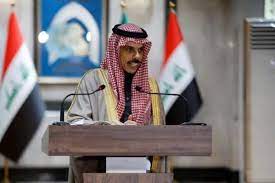
Saudi Arabia's Foreign Minister Prince Faisal bin Farhan Al Saud has said that the strategy of Arab countries regarding Syria has proved wrong. According to him – the strategy of isolating Syria did not prove to be correct. There is a refugee crisis and sooner or later a solution to this issue will have to be found based on humanity, and talks will have to be held with Syria.
Saud also targeted the Gulf Cooperation Council (GCC) in gestures. Said- Many times we make big forums, but how will they be used properly? We have to decide this too.
return the displaced
Amidst the ongoing civil war in Syria, this issue was discussed in detail at the Munich Security Forum. For the first time, the countries involved in the meeting acknowledged that the strategy of isolating Syria had not proved effective.
During this, Saudi Foreign Minister Prince Faisal said – Civil war is going on there for 12 years. All Arab countries, including Saudi Arabia, helped and supported the rebel groups fighting against Syrian President Bashar al-Asr. Faisal said- Today all the countries including the Gulf States have accepted that this strategy was of no use.
Saud further said – Recently there was a tremendous earthquake in Turkey and Syria. It affected millions of people. Thousands died. We could not provide the help that should have been provided to Syria. Syrian refugees are taking refuge in neighboring countries, and because of this, the crisis is becoming more dangerous.
need to talk now
The Saudi Foreign Minister further said – Now it has become necessary that we have to talk to the Syrian government. This work has to be done if not today then tomorrow. The longer we wait, the worse the situation will be. At least to solve the refugee crisis, immediate steps have to be taken. After the earthquake, the foreign ministers of the UAE and Jordan visited Turkey and Syria.
Faisal did not give any answer whether he would also go to Damascus, the capital of Syria, or not. He said- We have sent help to those areas of Syria, which are under the control of the government there and where the earthquake has caused havoc.
More responsibility for Saudi
After the earthquake in Syria and Turkey, western countries did not help him much. Arab countries helped Syria through different means. The Saudi government is changing its strategy regarding Syria. The main reason for this is that Syria has been isolated by the US and Western countries, because of the close relations of President Bashar al-Assad with Russia. On the other hand, Israel and America's allies are helping the rebels in Syria.
In Syria, there has been a war between President Assad and the rebels for almost 15 years. This country has been destroyed due to the civil war. In recent days, Assad's forces, with the help of Russia, have captured much of the country. Apart from Russia, Assad is also getting help from Iran.


The controversy surrounding WhatsApp's upcoming username feature has intensified after the Indian
The fever of IPL 2024 will start from today. Defending champions Chennai Super Kings and Royal Ch
Congress leader Rahul Gandhi said that in the 1990s, the Congress ignored the interests of Dalits
Apple is going to introduce the iPhone 15 Series to its users today. With this series, four new i
A major box office battle is set to unfold in March. Two major films will clash: Ranveer Singh's
India A vs Australia A: India A Seal 162-Run Win as Kushagra Scores 159 and Mulani Claims 7 Wickets
India A defeated Australia A by 162 runs in the first unofficial Test at the Cricket Association
International Yoga Day 2024: PM Modi did yoga with the people of Kashmir at the Sher-e-Kashmir In
As the mercury rises, the garbage mountain in Ghazipur is on fire once again. The fire
Prime Minister Narendra Modi will be on a US tour from June 21. This tour is being given a lot of
Union Home Minister Amit Shah on Monday paid tribute to all the policemen who were martyred in th