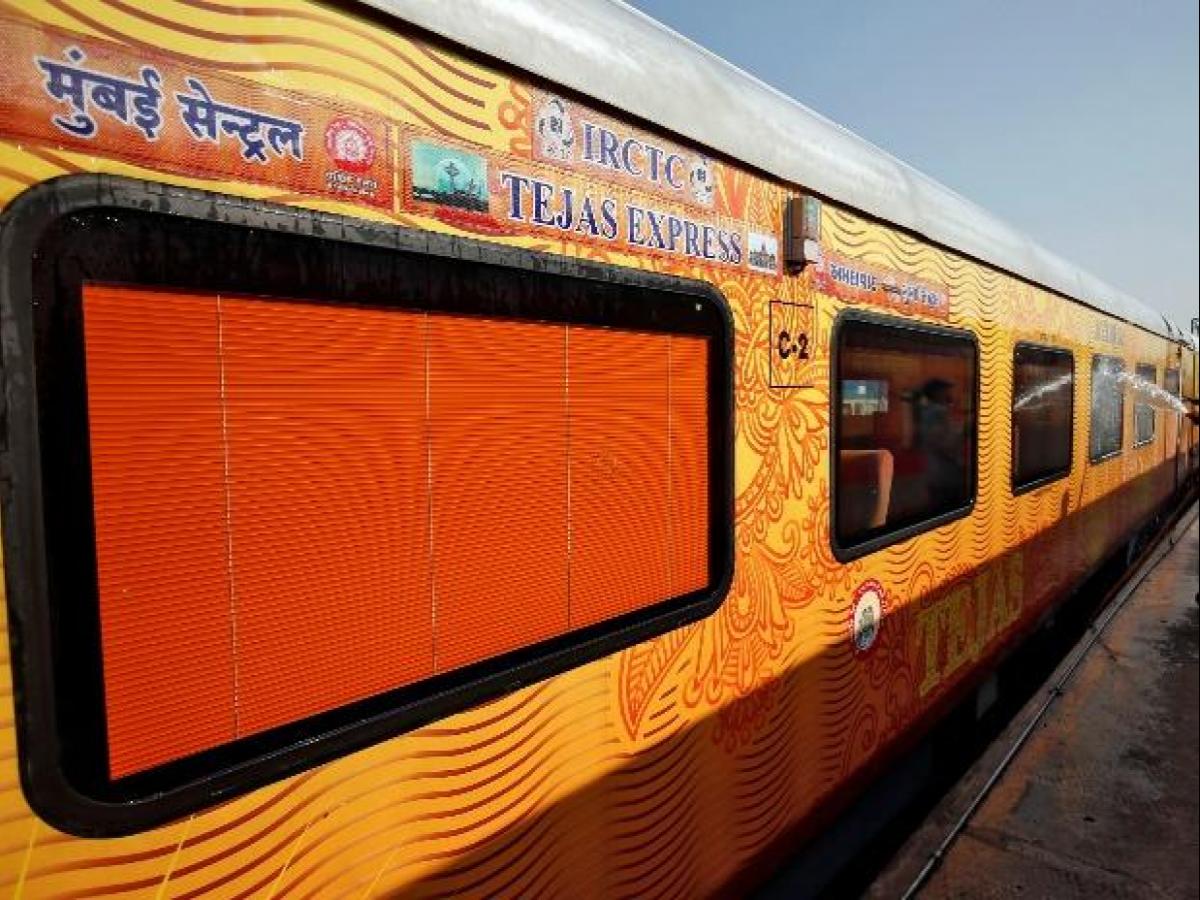
Uttar Pradesh Chief Minister Yogi Adityanath flagged off the Tejas Express train between Delhi and Lucknow on October 4, 2019. The government and several media organizations gave it the status of the first 'private train' of independent India. However, this train is operated by the Government of India Railway Catering and Tourism Corporation (IRCTC). Tejas can be considered a specimen of what a private train will look like on Indian railway tracks.
The AC ticket for Tejas Express is Rs 1,280 and the Executive Chair car ticket is Rs 2,450, which is significantly higher (AC ticket Rs 970 and Executive Chair car ticket Rs 1,935) compared to Swarn Shatabdi Express operated by Indian Railways. However, both trains had a dynamic system. In January 2020, IRCTC launched a second rail service between Mumbai and Ahmedabad as part of a massive campaign to privatize railway services.
With the plan of 151 private trains on 109 routes with an investment of around Rs 30,000 crore by 2023, the question arises whether private companies can compete against Indian Railways operating at highly discounted rates? Indian Railways charges only 57 percent of the cost of travel in the passenger segment while the recovery on suburban routes is around 40 percent. Based on recently available estimates, the railways charges around 36 paise per 10 km for commuters, but costs around 73 paise for the same distance. At the same time, the fee for AC chair car and executive class in Delhi-Lucknow Tejas Express is Rs 2.5 and Rs 4.8 per km respectively. A company official, a potential bidder for private rail service in India, said, "Nowhere in the world are trains run at the rate at which Indian Railways run."
It will be difficult for the railways to operate on higher subsidies and pay its employees. That is why I believe rates should increase in the future. Last month, GMR Group, Sterlite Power, Bharat Forge, JKB Infrastructure, Medha Group, RK Associates, Bombardier, IRCTC, and Bharat Heavy Electricals (BHEL) participated in a meeting and scheduled train speeds of 160 mph on railway tracks. Including many concerns. Currently, only the Gatiman Express running between Delhi and Jhansi is capable of running to this limit.
Before the lockdown, the average speed of passenger trains was about 44 kmph and that of freight trains was around 23 kmph. Besides, viability was also a major factor. Dinesh Kumar Kotha, co-founder and CEO of Confirmicut, a Bangalore-based online reservation app, feels that this should not be an issue. He says, 'The subsidy is only for the non-AC category. Private companies are expected to operate in the premium category, where there is no subsidy even for Indian Railways. He adds, "Also, in the immediate and dynamic pricing system, people are ready to pay higher ticket prices. In the case of Tejas plying on the Delhi-Varanasi route, IRCTC has proved that profit can be made with high prices and facilities like aviation companies.
Pricing concerns can be answered by Tejas Express. IRCTC has earned Rs 7.73 lakh in the first month. Tejas touched this string of earnings during the first month with an average seat travel of 62 percent. Kotha believes that services are viable at this level. He says, 'Each train will cost around 150 crores. This will include capital and marketing costs besides electricity and other charges paid to the railways. I believe that companies with 50-60 percent average seat travel will be able to achieve a break-even level at the trip level. He said, "With an average seat travel of around 70-80 percent for five years, you will get back almost all the investment."
A senior railway official also said that demand would not be an issue. The routes chosen for private trains are over 100 percent busy, so adding one more train will only help to meet the demand. A dynamic pricing system will also ensure feasibility. Subrata Nath, head of the Indian unit of the Spanish manufacturer Talgo, said, 'I believe there will be no upper limit on the fares of such trains. Currently, 30 percent of those using the Indian Railways travel in the air-conditioned category. They are ready to pay more when they get better services from a private company.
Besides, trains have an added advantage over aviation services. Trains pass through the city while airports are on the outskirts and people take a long time in movement and waiting, as a security check is required two hours before the flight of the aircraft. However, the entire process also involves competition and hidden costs. For example, IRCTC pays compensation of Rs 100 for delays of more than one hour on the New Delhi-Lucknow Tejas Express and Rs 200 for delays of more than two hours.


A little guest knocked at the house of late Punjabi singer Sidhu Moosewala's parents on Sunday. C
South star Pawan Kalyan's long-delayed film 'Hari Hara Veer Mallu' has finally been released toda
Jonny Bairstow Controversial Run Out MS Dhoni Ian Bell Video Gets Viral England's fortunes did no
The Supreme Court on Monday dismissed advocate Ashwini Upadhyay's plea seeking equal age of marri
President Draupadi Murmu will address the special session of the Arunachal Pradesh Legislative As
Maharashtra Chief Minister Eknath Shinde said that the projects and schemes which were stopped du
President Vladimir Putin's health suddenly deteriorated, and an army of doctors ran
Ever since the war between Russia and Ukraine began, there have been reports of President Vladimi
Earthquake tremors were felt in Himachal Pradesh's Chamba district late on Monday night. Accordin
Even today, there has been no increase in the prices of petrol and diesel by the oil companies. I
In how many days do symptoms appear in the body after coronavirus infection? Everyone is very con